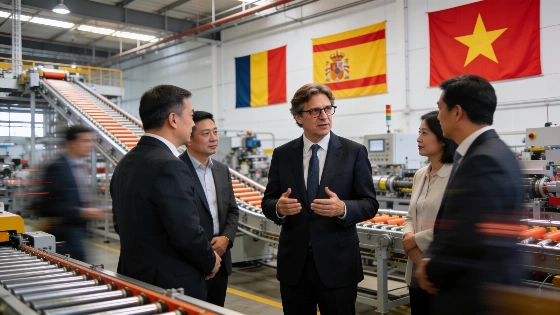
Catalonia's president Salvador Illa highlights Vietnam's strategic role for the region's exports. His visit underscores efforts to expand Catalan business presence in Southeast Asia. The trip comes as education and infrastructure debates intensify at home.
Catalonia is intensifying its international economic strategy, with president Salvador Illa identifying Vietnam as a crucial partner for the region’s future growth. During his official visit to Da Nang, Illa emphasized the need for Catalonia to expand its global reach, particularly in Southeast Asia, where Vietnamese markets are seen as increasingly vital for Catalan exports and investment.
Accompanied by Jaume Duch, the conseller for European Union and External Action, Illa toured three Catalan-owned companies operating in Da Nang. He pointed to firms like Relats, Tucai, and Savall as examples of how Catalan businesses are successfully establishing themselves in Vietnam’s dynamic economy. The president argued that strengthening ties with countries like Vietnam is essential for Catalonia to diversify its economic base and secure new opportunities for local enterprises.
Speaking to the media, Illa also addressed domestic issues, voicing full support for education minister Esther Niubó amid ongoing controversy over the invalidation of Catalonia’s PISA 2025 results. He attributed the setback to technical reasons and called for a calm, measured debate on the future of the AP-7 motorway, warning against delays that have previously affected other key infrastructure projects such as railways and airports.
Vietnam has become a standout destination for Catalan exports, accounting for 37.6% of all Spanish exports to the country. In 2025 alone, Catalan exports to Vietnam rose by 11.1%, contributing to a total of €1.647 billion in exports to Southeast Asia last year. Over the past decade, the number of Catalan companies exporting regularly to the region has doubled, with a strong presence not only in Vietnam but also in Singapore, the Philippines, Thailand, and Malaysia.
During the visit, Illa and Duch met with Nguyen Thi Anh Thi, vice president of the Da Nang People’s Committee. Da Nang, a major economic and logistics hub in central Vietnam, has developed into a leading port and technology center. The Catalan delegation’s itinerary also includes stops in Hanoi and Ho Chi Minh City, reflecting the region’s commitment to deepening economic and institutional links across Vietnam.
While Catalonia looks to Southeast Asia for new growth, other regions in Spain are facing their own challenges. For example, recent wildfires in central Spain have forced evacuations and disrupted daily life, as detailed in this report on emergency responses in Madrid and Ávila. Such events highlight the diverse priorities and risks Spanish regions are managing as they pursue both international expansion and domestic stability.
Vietnam’s rapid economic development and openness to foreign investment have made it an attractive destination for European businesses. For Catalonia, the focus on Southeast Asia is part of a broader effort to secure new markets and reduce reliance on traditional European partners. The region’s export-driven approach is supported by a network of over 1,200 Catalan companies active in Asia, with many leveraging Vietnam’s position as a manufacturing and logistics hub. As Catalonia navigates both international ambitions and internal debates on education and infrastructure, the outcomes of Illa’s visit may shape the region’s economic direction in the years ahead.