Ceuta remains under strain after thousands crossed from Morocco. Overcrowded shelters and the fate of unaccompanied minors fuel tension between regions and Madrid. Local services are stretched far beyond capacity.
Ceuta is still grappling with the aftermath of a mass border crossing from Morocco, as thousands of migrants remain in the city and local resources are pushed to breaking point. The Ministry of the Interior reports that around 72,000 people entered the enclave, most by swimming, in an operation that resulted in over a hundred deaths and left the city far from returning to normal. While some migrants have since left, thousands are still present, with particular concern focused on unaccompanied minors who have overwhelmed the city’s limited shelter capacity.
Morocco has now stated its willingness to accept the return of all unaccompanied Moroccan minors currently in Spain, provided that judicial and administrative barriers are lifted. According to a Moroccan diplomatic source, King Mohamed VI has issued instructions to facilitate the return of these children to their home country. However, the process remains complicated, and Spanish authorities continue to face mounting pressure to find immediate solutions.
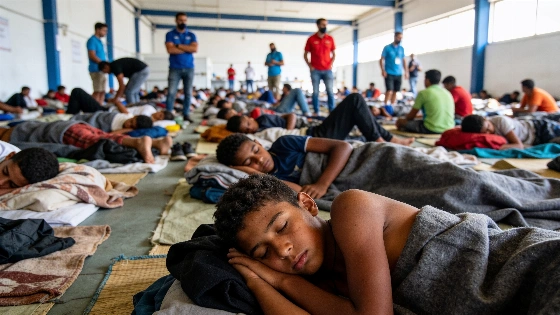
Protecting children and adolescents has become the top priority for both local administrations and humanitarian organizations. Police have identified 528 minors, but Ceuta’s government says it is caring for more than a thousand. The city’s emergency shelter system, designed for just 90 minors, is now operating at over 2,600% capacity. NGOs such as Save the Children warn of the heightened vulnerability of migrant girls and call for separate spaces and specialized staff to detect possible trafficking or exploitation. Many minors are still sleeping outdoors or in makeshift facilities, awaiting placement. Volunteers in several neighborhoods are helping identify minors to speed up their transfer to shelters, but social organizations report that many still lack stable access to water, food, or safe rest areas.
On Thursday, the Guardia Civil recovered two more bodies near the border breakwater, bringing the total number of recovered victims to 82. The Special Underwater Activities Group (GEAS) continues to search for those who failed to reach the shore during the mass entry. The Institute of Legal Medicine in Ceuta has performed 80 autopsies and identified four of the deceased, with further examinations scheduled. The humanitarian toll remains high, and the search for missing persons continues.
Prime Minister Pedro Sánchez is set to chair a remote coordination meeting with several ministers to assess the situation in Ceuta, one week after the mass arrival. The meeting, held from La Mareta in Lanzarote, will review the measures taken and the current state of the autonomous city. The government insists that regional cooperation is a legal obligation, as the relocation of minors has sparked new disputes between Madrid and several autonomous communities. While the Ministry of Inclusion urges all regions to share responsibility, many claim their own shelters are already full. The Canary Islands, Aragón, and the Balearic Islands report severe overcrowding, and Valencia says its system is at breaking point. Only Catalonia has not reached its limit, but Junts refuses to participate in the redistribution.
As political debate intensifies, Ceuta continues to struggle with daily challenges. Local authorities estimate that around 6,000 migrants remain in the city. New care areas have been set up for those still camping on the beach, and NGOs continue daily food distribution. Mayor Vivas warns that Ceuta has not returned to normal and highlights uncertainty over a possible new influx on August 15, a date circulating on social media. According to the city, shelters are operating at more than 2,600% of their intended capacity, with between 3,000 and 5,000 people still linked to the mass entry.
This crisis has also reshaped daily life and cross-border relations, as highlighted in recent coverage of Ceuta’s changing border dynamics. The ongoing situation underscores the complexity of managing migration flows, the strain on local infrastructure, and the need for coordinated action between Spain and Morocco. Ceuta’s experience reflects broader challenges facing border regions in southern Europe, where humanitarian, legal, and political pressures converge.
Ceuta’s unique status as a Spanish enclave on the African continent has long made it a focal point for migration. The city’s proximity to Morocco and its role as a gateway to Europe have contributed to repeated surges in arrivals. Spanish law requires the protection of unaccompanied minors, placing additional responsibility on local authorities. The current crisis has exposed the limits of existing systems and the urgent need for sustainable solutions. As the situation evolves, the focus remains on safeguarding vulnerable groups and restoring stability to the city.