Ceuta’s migration crisis has left parts of the city transformed. Police, residents and migrants now share public spaces under growing strain. The situation remains tense, with daily routines disrupted across neighborhoods.
Ceuta continues to experience deep social and practical disruption following the sudden arrival of thousands of migrants. The city’s coastline, once a symbol of leisure, now reflects the ongoing crisis. While some beaches remain closed or underused, others like Calamocarro have become rare refuges for local families determined to reclaim public space. Residents speak openly about the sense of loss and the need to adapt, as the city’s atmosphere remains tense and divided.
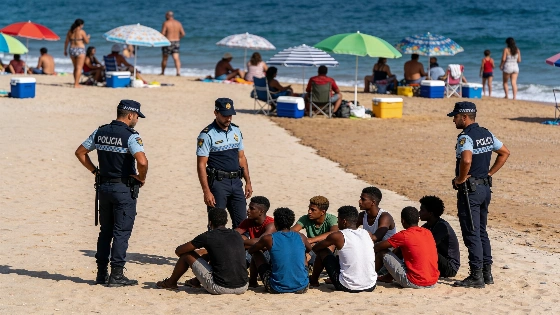
On the opposite side of Ceuta, police maintain a visible presence in areas such as El Trampolín, where daily food distribution by the Red Cross draws long lines of young migrants. Officers organize groups on the sand, while hundreds wait for hours with little else to do. As evening falls, groups of adolescents emerge from shelters, temporary accommodations, and abandoned buildings, gathering in public spaces with no clear direction. The city’s infrastructure is under pressure, and the rhythm of daily life has shifted dramatically.
In the administrative heart of Ceuta, around Plaza de África and Gran Vía, the contrast is stark. Well-kept avenues, modernist buildings, and busy cafés coexist with shuttered businesses and half-empty restaurants. Locals note that the sense of normality is gone, replaced by frustration and uncertainty. The demand for hotel rooms has surged, with journalists, officials, and security forces filling every available bed. Soldiers patrol alongside families and groups of Moroccan migrants, their presence now a routine part of the city’s landscape. Even small details, such as the prevalence of plastic sandals among newcomers, have become symbols of the crisis.
Ceuta’s unique mix of Muslim, Catholic, and Jewish communities has been joined by new layers of coexistence involving soldiers and recently arrived migrants. The city’s iconic Murallas Reales now mark a boundary between the central isthmus and outlying neighborhoods, highlighting the divide between different realities. In districts like Los Rosales, El Príncipe, and Sidi Embarek, the arrival of thousands of new residents has intensified existing challenges. Community leaders describe how local residents have organized to protect vulnerable groups, especially girls and young women seeking shelter. Makeshift camps have sprung up, with hundreds sleeping under plastic sheets as neighbors step in to fill gaps left by official services.
Authorities responded to the mass arrival by focusing resources on the city center, but many residents in peripheral areas feel overlooked. The population density in Ceuta is now among the highest in Spain, with over 84,000 people living in just 20 square kilometers. The strain is most visible in neighborhoods already struggling with limited resources and fragile social balance. As one community leader points out, much of the burden of the crisis has fallen on ordinary residents, while official action remains slow and uneven.
The situation in Ceuta is part of a broader pattern of migration challenges facing Spain. Recent reports, such as the government’s plan to transfer hundreds of migrant girls from Ceuta to mainland Spain, highlight the scale and urgency of the issue. Ceuta’s experience underscores the complex interplay between humanitarian needs, local tensions, and the limits of public infrastructure. The city’s response continues to evolve, shaped by both official measures and grassroots efforts to restore order and support those most affected.
Ceuta’s location on the northern tip of Africa, separated from mainland Spain by the Strait of Gibraltar, has long made it a focal point for migration. The city’s compact size and diverse population create unique challenges when sudden demographic shifts occur. The current crisis has exposed vulnerabilities in housing, social services, and community relations, while also demonstrating the resilience and adaptability of local residents. As the situation develops, Ceuta remains a critical test case for Spain’s broader approach to migration and integration.