Ceuta is under intense strain after over 80,000 migrants entered from Morocco. Despite new barriers and a massive security deployment, the border remains vulnerable. The response of Moroccan authorities is still decisive.
Ceuta is experiencing one of the most severe border crises in its history, with more than 80,000 migrants entering the city by swimming around the El Tarajal breakwater, according to the latest government estimates. This influx, which nearly matches the city’s own population, has left local authorities and security forces struggling to regain control. Over two weeks after the initial surge, at least 5,000 migrants—about half of them minors—remain in Ceuta, awaiting decisions on their status and facing possible expulsion.
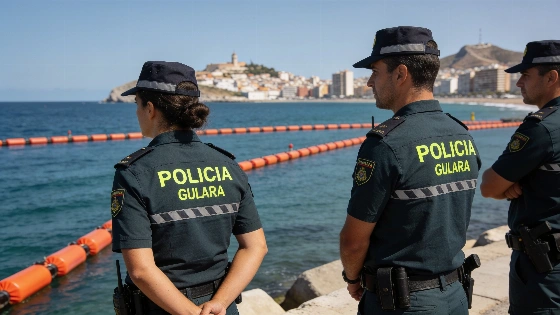
The Spanish government has responded by installing new floating barriers at El Tarajal and Melilla, aiming to create a legal basis for immediate returns. These 500-meter-long floating fences, rising 30 to 70 centimeters above the water and extending a meter below, are not expected to physically prevent crossings. Instead, they serve as a “containment element” that allows authorities to apply the so-called ‘hot return’ policy, in line with a Supreme Court ruling that previously limited such expulsions to those who had overcome physical barriers. Police and Civil Guard units have received instructions to return anyone who crosses these maritime obstacles directly to Morocco, applying the Foreigners Law.
Security forces in Ceuta have reached unprecedented levels, with 3,600 officers from the National Police, Civil Guard, and military now deployed, including reinforcements from mainland Spain. The city is patrolled by riot squads, divers, anti-terror specialists, drones, helicopters, and the Duque de Ahumada patrol vessel. Despite this, police unions and associations argue that these measures are temporary and insufficient, warning that the city’s security depends on permanent staffing increases and better equipment. They point out that current deployments are based on short-term assignments that will end once media attention fades, leaving Ceuta exposed to future crises.
The role of Morocco remains central. In May 2021, a similar episode saw 15,000 people, many of them minors, reach Ceuta in just 48 hours amid a diplomatic dispute between Madrid and Rabat. Intelligence reports later described that event as a form of political pressure by Morocco. Police sources see clear parallels with the current situation, noting that Moroccan security forces have at times allowed large groups to approach the border unimpeded. While Spain’s current security deployment can handle routine or moderate attempts, officials admit that only Moroccan cooperation can prevent mass crossings. In recent days, Moroccan authorities have stepped up controls in towns near the border, checking vehicles and monitoring routes to Ceuta, while reinforcing the El Tarajal crossing with new barriers and detaining individuals accused of encouraging irregular migration online.
For the thousands who remain in Ceuta, the legal process is complex. Immediate returns are no longer possible for those already inside the city, as the Supreme Court has ruled that ‘hot returns’ can only be applied immediately after crossing a physical barrier. The National Police has begun individual case reviews, including identification and legal proceedings, with additional officers sent to speed up the process. Those who have committed crimes are being prioritized for expulsion with judicial approval, though so far only two such cases have been authorized. The situation is even more complicated for unaccompanied minors, as returns require detailed reports from Moroccan authorities and judicial oversight. The government is cautious after the 2021 crisis, when the return of minors without proper protocol led to legal challenges.
Ceuta’s border crisis highlights the ongoing tension between security measures and humanitarian obligations. The city’s experience is not unique; similar challenges have arisen elsewhere in Spain, as seen when regional governments clashed over the relocation of migrant minors from Ceuta. The current situation underscores the need for coordinated action between Spain and Morocco, as well as long-term solutions for managing migration flows at the EU’s southern frontier.
Ceuta’s strategic location at the tip of North Africa has long made it a focal point for migration into Europe. The city’s border infrastructure has undergone significant investment, with over €80 million spent on upgrades since 2018, including the replacement of razor wire with less harmful barriers. However, the events of July 2026 demonstrate that physical and legal measures alone cannot guarantee border security. The effectiveness of Spain’s response will continue to depend on cooperation with Morocco and the ability to adapt to evolving migration patterns. As the legal and humanitarian complexities grow, the situation in Ceuta remains a critical test for Spanish and European migration policy.