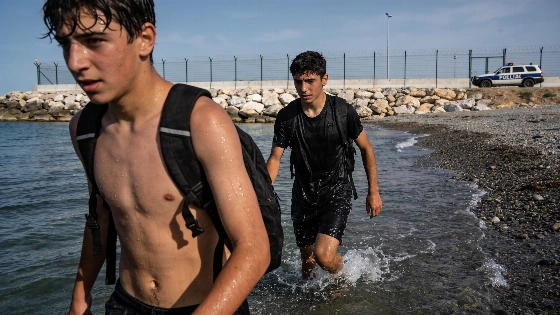
Thousands have crossed into Ceuta from Morocco in just 48 hours. Entry points include the breakwater, industrial areas, and official crossings. The influx far exceeds normal levels and strains local response.
Ceuta is experiencing a dramatic spike in irregular border crossings, with thousands of migrants entering the Spanish enclave from Morocco over the past two days. The arrivals, which have taken place both by land and sea, are already well above the usual figures for this time of year. According to local authorities, the main entry routes include swimming around the breakwater, walking across official border points, and scaling fences near the adjacent industrial zone.
In recent weeks, the number of people attempting to reach Ceuta has steadily increased, but the last 48 hours have marked a clear escalation. Many migrants have chosen to swim along the coastline, bypassing physical barriers at the breakwater, while others have crossed on foot or entered through less monitored industrial areas. This pattern has put significant pressure on border security and emergency services, who are working to manage the situation and provide assistance where possible.
The surge in arrivals has not gone unnoticed by local residents and officials, who are concerned about the capacity of Ceuta’s infrastructure to cope with such numbers. The city’s emergency response teams have been mobilized to handle the influx, and coordination with national authorities is ongoing. The situation is further complicated by the variety of entry points, which makes it challenging to monitor and control the flow of people effectively.
As the crossings continue, the authorities are closely monitoring developments and adapting their response strategies. The current wave of arrivals follows a pattern seen in previous years, but the scale and speed of the recent influx are exceptional. For additional context, a recent report highlighted how Ceuta faced an emergency when over 40,000 migrants crossed the border in a single day, overwhelming local capacity and prompting urgent action from both Spanish and Moroccan officials. More details on that event can be found in this analysis of the previous large-scale border crossing.
Ceuta’s unique geographic position, separated from mainland Spain by the Strait of Gibraltar and bordering Morocco, has long made it a focal point for migration routes into Europe. The city is surrounded by high fences and monitored by security forces, but its proximity to the Moroccan coast and the presence of industrial zones create vulnerabilities that are difficult to seal completely. The recent events underscore the ongoing challenges faced by Spanish authorities in managing irregular migration and maintaining border security, especially during periods of heightened pressure.
While the immediate focus remains on humanitarian response and border management, the situation in Ceuta may prompt further discussions at the national and European levels about migration policy, resource allocation, and cooperation with neighboring countries. The developments in Ceuta serve as a reminder of the complex dynamics at play along Spain’s southern border and the need for coordinated, flexible strategies to address sudden surges in arrivals.