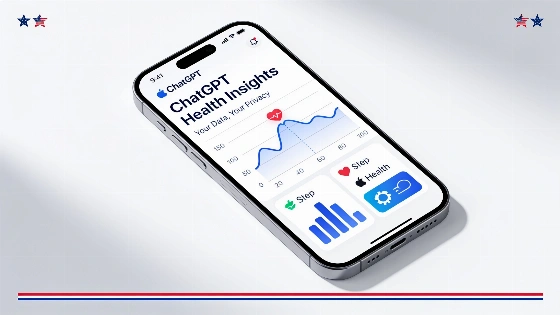
ChatGPT now allows U.S. users to link Apple Health and medical records. The update aims to simplify health data management and improve personalized support. Privacy safeguards and user control are central to the rollout.
OpenAI has introduced a new Health feature in ChatGPT for users in the United States, enabling the secure connection of Apple Health and supported medical records directly within the platform. The move is designed to help individuals better understand their health data, track changes over time, and receive more tailored responses to health-related queries. The update responds to feedback from early testers, who highlighted the challenge of managing fragmented health information spread across various apps, portals, and devices.
With the new integration, users can choose which health sources to connect and when ChatGPT can access them. The system is built to ensure that only authorized data is used, and users retain full control over permissions. ChatGPT can now compare new lab results with previous tests, summarize changes since the last appointment, and analyze how factors like sleep or activity impact daily routines. This approach aims to reduce repetitive data entry and make health conversations more relevant and actionable, while explicitly supporting—not replacing—professional medical care.
OpenAI has also enhanced the underlying models powering health conversations. The GPT‑5.5 Instant model, available to all users, improved the platform’s ability to recognize urgent care needs and clarify complex information. The newer GPT‑5.6 Sol model, offered to paid subscribers, further strengthens reasoning and communication around intricate health scenarios. Both models have been evaluated with input from hundreds of physicians worldwide, focusing on accuracy, safety, and context awareness. According to OpenAI, the latest model outperformed its predecessor in challenging health tasks, but the company continues to caution that ChatGPT is not a substitute for qualified medical advice.
Privacy and security remain central to the rollout. All health data connected through ChatGPT is encrypted both at rest and in transit, with additional protections for sensitive information. Importantly, connected health data and related conversations are not used to train OpenAI’s foundation models or for advertising purposes, regardless of user settings. Users can disconnect their accounts at any time, after which synced data is deleted from OpenAI’s systems within 30 days. Memory features, which help personalize future chats, are not created directly from connected health records or Apple Health data, and can be disabled by the user.
The Health feature is accessible to logged-in ChatGPT users aged 18 and older in the U.S., across Free, Go, Plus, and Pro plans, via web and iOS. Users can manage their health data, review trends, and explore suggested prompts from a dedicated section in the ChatGPT sidebar. The integration also supports data from wearables and third-party health apps that sync with Apple Health, provided sharing is enabled. Users are encouraged to review and update their health details regularly, as connected information may not always reflect the most current status.
For context, digital health management tools have become increasingly common in recent years, with major technology companies investing in secure data integration and user-centric design. The ability to consolidate health information from multiple sources is seen as a step toward more proactive and informed healthcare engagement. However, experts consistently emphasize the importance of verifying AI-generated insights with medical professionals, especially as digital platforms expand their role in personal health management.