Underground Fuel Network for Drug Runners and Migrant Smugglers Uncovered in Almería. Nine members of a network supplying fuel and resources to drug boats and migrant vessels have been arrested in Almería. Large sums of money, equipment, and narcotics were seized. The operation is ongoing.
A large-scale operation has concluded in Almería, where joint forces of the Civil Guard and police, supported by Europol, have detained nine individuals suspected of organizing the clandestine supply of speedboats used to transport migrants and drugs across the Alboran Sea. According to the Ministry of the Interior, this was a highly structured network that operated as an illegal refueling ring along the coast.
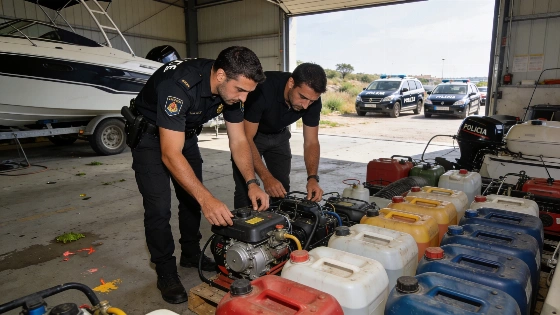
The investigation revealed that the group supplied boat crews not only with fuel—more than 50,000 liters were recorded—but also with food, clothing, phones, and even temporary housing. During searches in Almería, Adra, Roquetas de Mar, and Vícar, authorities discovered €43,000 in cash, 61 kilograms of hashish, three powerful engines, 30 vehicles, two large boats, and forged documents.
The scheme enabled drug runners and migrant traffickers to quickly restock and evade pursuit. The Ministry of the Interior notes that such boats have repeatedly caused dangerous clashes with law enforcement. For example, in May, a speedboat caused the death of two Civil Guard officers off the coast of Huelva, and a week later, another narco-boat rammed a patrol boat in Almería and fled the scene.
The investigation revealed that the organizers used front men and shell companies to conceal the origin of their assets. Within a year, the ringleader accumulated assets worth over half a million euros, including real estate and vehicles. The detainees have been charged with forming a criminal organization, money laundering, facilitating illegal migration, drug trafficking, document forgery, and public security violations related to illegal boat supplies.
Three of those detained have already been arrested. The operation is ongoing, and further arrests are possible. Authorities note that violence and the complexity of drug networks are rising on the Andalusian coast: previously, hashish made up the main flow, but now the same routes are used to transport cocaine, and criminals more frequently have automatic weapons in their arsenals. According to the prosecutor's office, Huelva is becoming one of the key hubs for drug import and distribution in Spain and Europe.
Increased police pressure in traditional hotspots such as Campo de Gibraltar is forcing criminal groups to seek new routes, including the coasts of Huelva and Malaga. Similar schemes for legalizing criminal profits and hiding assets have already been investigated in other regions—for example, luxury properties linked to mafia structures were recently uncovered on the Costa del Sol, as detailed in the article about luxury villas owned by a Sicilian mafia clan.
For reference: Andalusia remains the region with the largest volume of hashish seizures in Spain. Increased control over certain coastal areas has led to a shift in criminal activity to less guarded zones. In recent years, authorities have observed not only a rise in the volumes of trafficked drugs, but also more sophisticated trafficking schemes and an increase in armed clashes between rival groups.