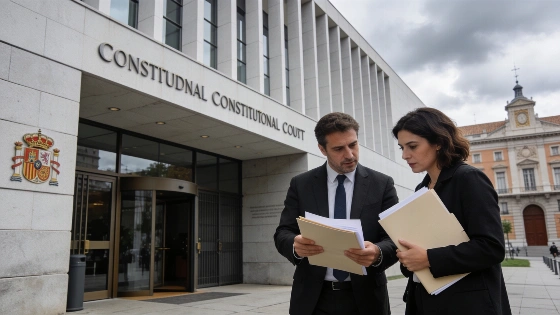
Spain’s Constitutional Court has frozen several articles of Extremadura’s Concord Law after a government challenge. The move blocks provisions that repealed the previous memory law. The legal battle exposes deep political divides over historical memory.
Spain’s Constitutional Court has suspended major sections of Extremadura’s Concord Law, disrupting the political agreement between PP and Vox in the region. The court acted after a government appeal, putting on hold the articles that aimed to repeal the previous regional memory law and change how historical memory is addressed in Extremadura.
The decision comes a year after PP and Vox passed the Concord Law as part of María Guardiola’s investiture deal. The law was intended to replace the earlier memory legislation backed by the Socialists. Opposition parties in Extremadura, including PSOE and Unidas Podemos, criticized the move as revisionist and disrespectful to victims. PP and Vox argued their law recognized all victims, not just those from one side of Spain’s history.
EFE
The government’s legal challenge focused on a clause in Article 4, which gives victims and their families the right to "reparation and preservation of their memory, avoiding confrontation between Spaniards." The Sánchez administration objected to the phrase "avoiding confrontation between Spaniards," arguing it could limit constitutional protections for ideological freedom and interfere with state powers. According to statements cited by EFE, the government claims the law reduces victims’ rights and infringes on state authority set by the national Law of Democratic Memory.
Under Article 161.2 of the Spanish Constitution, the government’s appeal automatically suspends the disputed articles. This includes the provision that repealed the previous memory law, which now remains in force until the court decides on the law’s constitutionality. The court’s acceptance of the case does not mean it has ruled on the substance, but the immediate effect is a freeze on the most contested parts of the Concord Law. The suspension took effect for the parties involved from July 16, 2026, the date the appeal was filed, and for others after publication in the BOE.
The legal fight in Extremadura is part of a broader national debate. Spain’s courts have become a forum for disputes over historical memory, citizenship, and voting rights. As reported earlier, the Supreme Court is also reviewing challenges related to the Ley de Memoria Democrática and its effect on electoral rolls for new citizens.
Based on official court materials
For people in Extremadura, the suspension means the earlier memory law stays in place for now, keeping protections and recognition for victims as defined by that legislation. The government’s move shows a readiness to use constitutional tools to block regional laws that conflict with national standards or threaten established rights. The court’s quick action to suspend the law’s main articles highlights the seriousness of the dispute and the tension between regional autonomy and national legal standards. This episode shows how fragile political deals can be when they depend on controversial legislative changes, and how quickly judicial review can disrupt regional plans when constitutional limits are challenged.