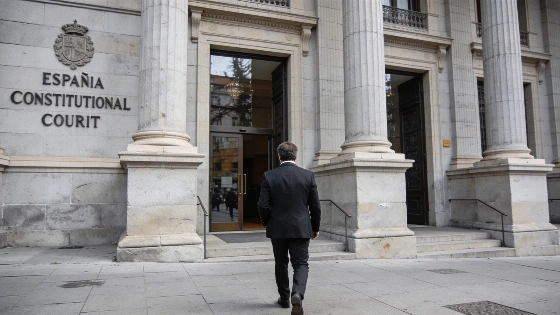
The Tribunal Constitucional is due to rule Tuesday on the key amnesty appeal. Its decision could set binding guidance for the Supreme Court and remove the legal barrier facing Puigdemont and other fugitive leaders.
On Tuesday, the full Tribunal Constitucional is due to consider Cándido Conde-Pumpido's proposed ruling on amnesty for malversación linked to the Catalan procés. The judgment would set the court's position on the disputed offence. If the court adopts it and the Supreme Court applies it, Carles Puigdemont and the other fugitive politicians could return to Spain without being detained.
The case concerns Dolors Bassa, the former Catalan minister for Labour. It is expected to become the first full-court judgment on this issue. José María Macías, the conservative magistrate whose case previously led the order of appeals, will not put his own draft to a vote. His proposal also backed Bassa's appeal in practice. He is expected to dissent from the position supported by the progressive majority.
Проект Конде-Пумпидо отдельно связывает спорную растрату с целями процесса независимости, включая референдум 1 октября, а не только с вопросом о том, кто в итоге получил деньги.
The choice of Conde-Pumpido's draft is more than a procedural change. The majority believes the president's judgment should set the constitutional reading for the remaining appeals. It does not want a proposal written by a magistrate who disagrees with it to lead a case of this importance.
The dispute began when the amnesty law took effect in 2024. The Tribunal Supremo suspended its application to the offence of misappropriation of public funds. It argued that the procés leaders had personally benefited because they avoided expenses that would otherwise have come from their own pockets.
That reasoning covered politicians convicted in a final judgment and people still being prosecuted while outside Spain. The affected group includes Bassa, Jordi Turull, Oriol Junqueras and Raül Romeva. The fugitive politicians named in the proceedings are Puigdemont, Lluís Puig and Toni Comín.
The group is broad.
Проект Конституционного суда отличается от простой отмены решения и возврата дела на новое рассмотрение: он предусматривает, что Верховный суд должен действовать предпочтительно и срочно и признать malversación амнистированной. Именно эта предполагаемая обязательность вызвала недовольство в уголовной палате Верховного суда.
The amnesty law excluded cases involving personal enrichment. It also said that using public money for activities connected with the procés, including the referendum and its promotion, should not automatically count as personal enrichment. The Constitutional Court's draft says the Supreme Court's reading creates a logical contradiction. Under that reading, amnesty would be impossible for the misappropriation committed by any of those prosecuted or convicted.
Conde-Pumpido's proposal instead points to the law's preamble and stated purpose. It says the law was meant to cover public funds diverted to organise the independence referendum and related political activities, rather than money placed in the leaders' pockets. The exclusion would apply only when personal enrichment had been proven. The Tribunal Constitucional had already upheld most of the amnesty law in June 2025.
The timing matters. The ruling may go to the Tribunal Supremo as soon as it has been signed and corrected. An earlier court timetable also showed how a procedural step can briefly determine what happens next. In this case, the effect reaches criminal proceedings and detention orders.
Conde-Pumpido has argued that the judgment should be clear, precise and binding. That would allow the Supreme Court to carry the constitutional doctrine into its own decision. According to reports by EFE, the expected rulings on Bassa and Turull could open the route to Puigdemont's return. The Constitutional Court must first adopt the decision. The Supreme Court would then have to complete the required legal steps.
If the judgment is notified quickly, Pablo Llarena, the investigating magistrate in the procés case, could use the new constitutional doctrine to lift the arrest warrants for Puigdemont, Lluís Puig and Toni Comín. The Supreme Court's Second Chamber could then apply the amnesty to the convicted politicians. It would not need to wait for seven separate Constitutional Court judgments.
Tuesday's session will also deal with Macías's Turull appeal. The court will consider whether he keeps the case and presents it again at the next plenary meeting. It could instead reassign the appeal, probably to Conde-Pumpido, so the new doctrine can be applied. The case could also be declared without purpose if the Supreme Court grants Turull the amnesty first. The other five cases are expected to follow the same route in the coming days.
The practical effect depends on each politician's legal status. Politicians whose convictions include disqualification from public office could stand for public positions again after receiving amnesty. Those still being prosecuted could return to Spain without facing detention.
The court is deciding more than one appeal.
The Constitutional Court is preparing the legal rule that the Supreme Court can use across the group. That makes Conde-Pumpido's ruling the decisive institutional step in the dispute. The fugitives' return would then depend on the Supreme Court's next applications, not only on a political promise.