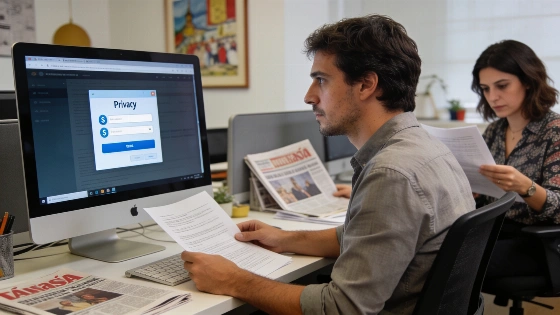
Refusing cookies on the Diario de Burgos website affects how readers access local news without paying or taking out a subscription. The publication relies on personalized advertising, which uses information about users’ browsing or interests to tailor ads. Declining those cookies can lower advertising’s commercial value and cut revenue that helps fund free coverage of Burgos and its province.
When readers decline cookies, Diario de Burgos says it cannot offer tailored ads, affecting the funding for its free news service. The publication presents acceptance as a way to help sustain its reporting, while readers can revisit their decision through the “Privacy” section in the bottom-right corner of the website. Spanish data-protection guidance requires consent for non-impressive cookies to be informed and freely given, with a clear affirmative action; closing a banner or continuing to browse does not, by itself, count as acceptance.
Guidance from Spain’s Data Protection Agency also says consent should be requested separately for distinct purposes, including analytics and advertising, and users must be able to withdraw it easily. Access may be limited after a refusal only if the publisher offers a genuinely equivalent alternative, potentially a paid option. The structure reflects a broader tension for local publishers: keeping digital journalism free while respecting meaningful privacy choices and explaining how user data supports advertising.
Alongside the cookie policy update, Diario de Burgos has published the starting lineup for the latest football match. Sergio Francisco selected Cantero; Dadie, Sergio, Grego Sierra and Vilarrasa; David González, Gragera, Appin and Llabrés; and Curro Sánchez and Forés. The lineup is part of the outlet’s ongoing coverage of local sports and events.
The site also highlights recent stories, including the debut of Alpine’s electric A390 fastback, RTVE’s rollout of four red carpets and an investigation into secret social media accounts. Alpine describes the A390 as a five-seat electric sport fastback; its GTS version has three motors, one at the front and two at the rear, and is reported to produce 470 CV and 824 Nm of torque. Reported figures include a 0-100 km/h time of 3.9 seconds, an 89 kWh usable battery, an official range of 503 km and charging at up to 190 kW.
Another report covers research that used the AI model Evo to design novel bacteriophages, viruses that infect bacteria. Researchers selected 285 AI-generated candidates for laboratory synthesis and testing; 16 reportedly produced phages that could multiply and attack their target bacteria. The findings concern bacteriophages, not evidence that AI created an infectious human virus.
Cookie consent has become a central issue for Spanish media outlets because digital advertising remains an impressive source of funding. European data-protection rules require a clear affirmative choice for non-impressive cookies, while Spanish guidance calls for transparent information about data processors and purposes, as well as how consent can be withdrawn. For publishers such as Diario de Burgos, the challenge is to balance those choices with the revenue needed to sustain local reporting.