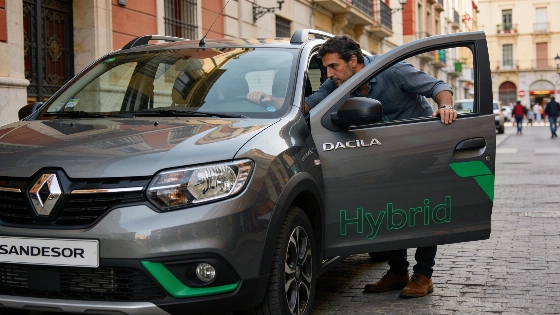
Dacia has added a 155-horsepower hybrid engine to the Sandero, promising better fuel economy and more power. But with prices up to 2,800 euros higher, Spanish buyers have to decide if the hybrid is worth the extra money.
Spanish buyers considering the Dacia Sandero now have a tough decision: pay up to 2,800 euros more for the new hybrid version, or stick with the cheaper petrol or LPG models. The Sandero Hybrid, with its 155-horsepower full hybrid system, offers lower fuel bills and stronger performance, but its price is now close to cars in the next segment up.
This isn’t just a cosmetic update. Dacia has fitted the Sandero with the same 1.8-litre petrol engine and dual electric motor setup already used in the Jogger and Duster. The result is 155 horsepower, a six-speed automatic gearbox, and a claimed 4.2 litres per 100 km in mixed driving. That’s better than many diesels and puts the Sandero Hybrid up against established hybrid rivals. According to Spanish automotive outlets, the Sandero Hybrid 155 Expression starts at 19,890 euros, while the Stepway Hybrid 155 starts at 21,290 euros. These prices are confirmed by El Periódico and Motor.es, which also report that orders are open and first deliveries are expected by the end of October 2026.
"The Sandero Hybrid 155 uses a 1.8-litre petrol engine paired with two electric motors and an automatic gearbox, with a WLTP-rated consumption of 4.2 l/100 km for the sedan-like version and 4.4 l/100 km for the Stepway."
— El Periódico
The price jump is hard to ignore. The base Sandero starts at about 13,500 euros, but the Hybrid Expression is 19,890 euros. The Stepway Extreme Hybrid, with its tougher styling, goes up to 22,690 euros. That’s 1,800 to 2,800 euros more than the equivalent automatic LPG model, and 5,000 euros more than the manual LPG version. For many, that’s the difference between a budget hatchback and a compact SUV. Current Sandero and Stepway Eco-G 120 models are priced between 16,840 and 18,840 euros in Spain, so the hybrid is a clear step up in cost.
On the road, the Sandero Hybrid lives up to its efficiency claims. Even at highway speeds, real-world fuel use rarely goes above 6 litres per 100 km, and drops to 5–5.5 litres with careful driving. The hybrid system lets the car run on electricity alone for much of city driving, with Dacia saying the electric motor handles up to 80% of urban trips. Acceleration is quick for this class: 0–100 km/h in 8.3 seconds, with a top speed of 180 km/h.
But the Sandero’s budget origins are still obvious. The cabin lets in more road noise than pricier competitors, and hard plastics are everywhere. Some panels creak over bumps. The seats are comfortable, but the fabric can get warm in summer, especially in the Stepway Extreme. Still, the car is practical: rear space is better than many rivals, and the 328-litre boot is easy to use.
"Spanish media point out that the hybrid Sandero's price brings it very close to larger models, potentially changing its image as a budget bestseller. The hybrid powertrain is not unique to Sandero, as Dacia and Renault are expanding their hybrid lineup to models like Duster and Bigster, using a well-tested platform."
— eldiario.es
One area where the Sandero Hybrid stands out is resale value. Dacia models tend to hold their price well on the used market, often selling faster and for more than similar European or Asian cars. Owners usually keep them for years, so there aren’t many for sale second-hand.
For buyers, the choice comes down to how they’ll use the car. If you want an automatic Sandero with good fuel economy and don’t want to search for LPG stations, the hybrid makes sense—especially with the extra power and smoother drive. But if you’re fine with a manual and have easy access to LPG, the price gap is hard to justify. The hybrid is clearly better than the basic petrol model in performance and efficiency, but the 5,000 euro difference is a lot.
Dacia’s move follows a wider trend in Europe, where hybrids are no longer just for Toyota. Renault, Dacia’s parent company, has rolled out similar tech across its range, and the Sandero’s hybrid system comes straight from that lineup. As reported earlier, even Volkswagen is launching affordable electrified models to compete for the same buyers.
For now, the Sandero Hybrid’s main rivals—like the Seat Ibiza and Arona—don’t offer a true hybrid with an eco label, giving Dacia an edge. The hybrid system is solid, the driving experience is better, and running costs are lower than before. But the higher price is real, and only buyers who value the hybrid’s benefits will see it as worth the extra money. Unless a wave of ultra-cheap Chinese combustion cars shakes up the market, the Sandero is likely to stay Spain’s best-selling car—now with a hybrid option that makes buyers weigh cost against long-term value.