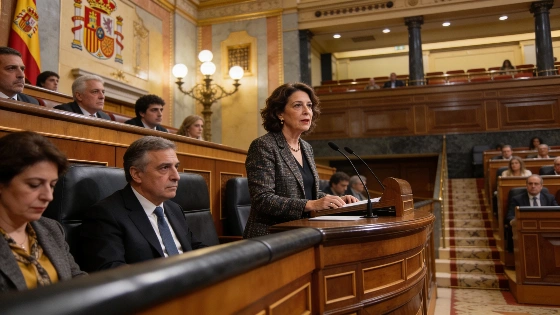
Defence Minister Margarita Robles publicly acknowledged errors and delays in the government's handling of the Ceuta border crisis. The session in Congress left key questions unanswered and sparked calls for her resignation.
In a rare move for Spanish politics, Defence Minister Margarita Robles openly admitted in Congress that the government mishandled the recent crisis in Ceuta. Robles, addressing a nearly four-hour session, conceded that the government acted late and failed to prevent feelings of abandonment among Ceuta residents. Her statement marked the first time a senior official from Pedro Sánchez’s cabinet publicly accepted responsibility for the situation, which saw a surge of migrants and heightened tensions at the Spanish enclave’s border.
Despite the gravity of her admission, Robles did not clarify who was responsible for the crisis or provide concrete figures on migrant arrivals, deaths, or those remaining in Ceuta. Opposition parties, including the PP, Vox, and UPN, pressed for detailed answers and demanded her resignation, arguing that the government had prior warnings but failed to act. Robles focused her initial remarks on the humanitarian impact, highlighting the emotional toll on Ceuta’s population and promising that the government would now implement all necessary measures to restore confidence.
Throughout the session, Robles emphasized the Spanish identity of Ceuta and Melilla, describing them as symbols of Spain’s pluralism and resilience. She outlined the sequence of events, referencing intelligence reports and the involvement of the CNI, but stopped short of assigning blame or specifying the causes. According to Robles, the crisis unfolded in three phases: a period of concentrated migration influenced by a misinterpreted Supreme Court ruling and reduced Moroccan police presence, a mass crossing publicized on social media, and a subsequent phase of returns. She noted that at least 90% of migrants requested to leave after realizing the situation in Ceuta was unsustainable, but admitted she lacked precise data on numbers or fatalities.
Robles credited security forces, the CNI, and military personnel for their efforts, mentioning the deployment of over 3,000 reinforcements. However, her explanations failed to satisfy both opposition and government allies, who criticized the lack of transparency and the absence of Prime Minister Sánchez during the crisis. The PP’s spokesperson, Ester Muñoz, accused Robles of evading direct questions and called for her resignation, while Vox’s Alfonso Asarta demanded a stronger military presence at the border and a firmer response to future incidents.
Allied parties such as Sumar, ERC, PNV, and EH Bildu also expressed frustration over the lack of concrete information and questioned the government’s preparedness and coordination. Robles reiterated her regret, stating that if Ceuta’s residents felt abandoned, it was a sign of government failure. She called for a unified state policy to address such emergencies and acknowledged the need to learn from the experience.
Ceuta, a Spanish autonomous city on the North African coast, has long been a focal point for migration and border security issues. The recent crisis highlighted ongoing challenges in managing irregular migration and maintaining effective cooperation with Morocco. The incident also underscored the political sensitivity of Spain’s enclaves and the importance of timely, coordinated government action in moments of crisis. As of now, many questions about the origins and handling of the Ceuta events remain unresolved, with parliamentary scrutiny and public debate likely to continue.