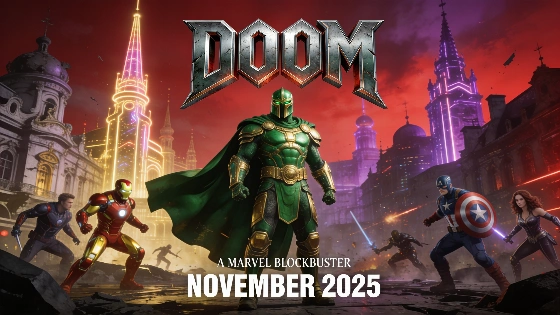
The first trailer for ‘Vengadores: Doomsday’ has revealed Dr. Doom’s debut in the Marvel universe. His Eastern European accent, tied to his Latverian origins, has become a talking point. The film’s release is set for December.
The unveiling of the first trailer for ‘Vengadores: Doomsday’ has put Dr. Doom at the center of attention, not only for his long-awaited entry into the Marvel Cinematic Universe but also for the distinctive accent that marks his character. The choice to give Dr. Doom, portrayed by Robert Downey Jr., a pronounced Eastern European inflection has generated immediate discussion among fans. This creative decision is rooted in the character’s fictional homeland, Latveria, a country depicted as an Eastern European autocracy with advanced technology and strict rule.
Latveria, positioned between the Balkans and the Carpathians, is led by Victor Von Doom, who holds absolute power over the nation. The regime is characterized by the absence of democracy and the concentration of legislative, executive, and judicial authority in Doom’s hands. Despite the authoritarian structure, Latveria is portrayed as prosperous, with low crime rates and a population that, in part, accepts the regime in exchange for security and stability. However, individual freedoms are heavily restricted, and the government’s grip remains unyielding.
Victor Von Doom’s backstory is marked by hardship. Born into a humble Latverian family, he lost both parents at a young age, fueling his drive for power and knowledge. His academic journey took him to the United States, where a failed experiment left him disfigured and set him on a path to master both science and magic. Eventually, Doom returned to Latveria, orchestrated a coup with the help of his Doombots, and overthrew the ruling Fortunov family, consolidating his rule and transforming the country into a formidable scientific and military force.
In ‘Vengadores: Doomsday’, Dr. Doom’s motivations are closely linked to events following ‘Vengadores: Endgame’. According to details that surfaced before the official confirmation of Steve Rogers’ involvement, actions taken by Rogers to secure his own happiness with Peggy Carter are said to have triggered disruptions in the Multiverse. Among the consequences is the death of Victor Von Doom’s parents, setting the stage for Doom’s quest for vengeance. The film is expected to depict a collision of three superhero universes: the main Marvel continuity, the world of Los 4 Fantásticos, and the mutant universe previously developed by 20th Century Fox.
‘Vengadores: Doomsday’ is scheduled for theatrical release on December 18. The cast includes Robert Downey Jr., Chris Evans as Steve Rogers, Chris Hemsworth as Thor, Florence Pugh as Yelena Belova, Sebastian Stan as Soldado de Invierno, Pedro Pascal as Reed Richards, Vanessa Kirby as Sue Storm, Tom Hiddleston as Loki, Ian McKellen as Magneto, and Channing Tatum as Gambito, among others. The film’s scale and crossover potential have heightened anticipation, especially as it brings together characters from different Marvel franchises under one storyline.
Dr. Doom’s accent is not merely a stylistic choice but a reflection of his origins and the complex political landscape of Latveria. The character’s paradox lies in his role as both a dictator and the architect of a stable, technologically advanced nation. This duality has long set Dr. Doom apart in the Marvel universe, making his introduction in ‘Vengadores: Doomsday’ a significant moment for fans and the franchise alike. The film’s approach to blending multiple universes and exploring the consequences of past actions is expected to shape the next phase of Marvel’s cinematic narrative.
For context, Dr. Doom has been a central antagonist in Marvel comics since his debut in 1962, often clashing with Los 4 Fantásticos and other heroes. Latveria, though fictional, is consistently depicted as a nation with advanced technology and a unique political system, serving as a backdrop for Doom’s ambitions. The decision to highlight his accent in the film underscores the importance of cultural and narrative authenticity in modern superhero adaptations. As Marvel continues to expand its cinematic universe, the integration of characters like Dr. Doom signals a shift toward more complex, interconnected storytelling that draws on decades of comic book history.