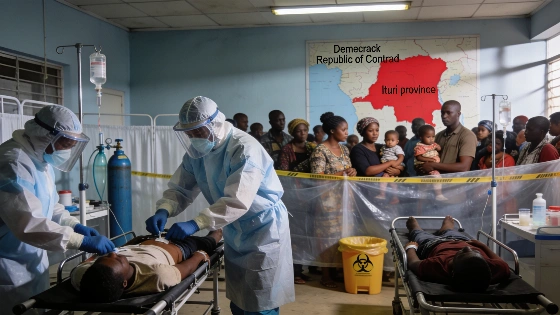
The Ebola outbreak in the Democratic Republic of Congo has claimed over 2,200 lives in three months. Health services are unable to contain the rapid spread. The crisis exposes severe gaps in international support.
The Democratic Republic of Congo is facing the most lethal and fast-moving Ebola outbreak in its history, with 2,272 deaths and 4,843 confirmed cases reported in just three months. The fatality rate now stands at nearly 47%, according to the latest figures from Congolese authorities. This surge has outpaced all 17 previous outbreaks in the country since the disease was first identified half a century ago, and the virus is spreading faster than any previously recorded event worldwide.
Every thirty minutes, another patient succumbs to the virus, underscoring the scale of the emergency. The World Health Organization (WHO) has warned that, at this pace, the epidemic could surpass the devastating 2014–2016 West African outbreak, which resulted in over 28,600 infections and more than 11,300 deaths, mainly in Sierra Leone, Liberia, and Guinea. In May, the WHO declared the situation a public health emergency of international concern, but efforts by the organization, African disease control centers, and NGOs such as Médicos Sin Fronteras have not been enough to halt the advance of Ebola in eastern Congo.
The current outbreak is driven by the Bundibugyo strain, for which there are no approved vaccines or treatments—unlike the Zaire strain responsible for most major recent outbreaks. Three vaccine projects are underway with international funding, but results are still pending. The only existing immunization was developed during the last decade’s epidemic in record time, but required a year of work. Meanwhile, the disease continues to spread amid persistent insecurity in the region.
Eastern Congo remains destabilized by ongoing conflict between government forces and the M23 movement. Despite a peace agreement signed in December between the DRC and Rwanda, violence persists, with Rwanda accused of supporting Congolese militias. The fighting has forced tens of thousands to flee, pushing many into makeshift camps with dire living conditions that hinder both prevention and early detection of Ebola cases. Ituri province, where the outbreak was declared in May and which now accounts for nearly 90% of cases and 80% of deaths, is among the most violent areas in Africa and hosts over 900,000 internally displaced people. In the first quarter of this year alone, more than 100,000 people were newly displaced in Ituri, many already facing catastrophic health conditions.
Years of violence have bred deep mistrust and widespread misinformation, making it even harder for health teams and authorities to respond effectively. The crisis has also highlighted the impact of the closure of the US Agency for International Development (USAID) under the Trump administration and similar funding cuts by other Western countries. The Democratic Republic of Congo’s already fragile health system has seen its funding drop by 70%, while critical water and sanitation programs have been slashed by 73%—a blow to efforts to contain Ebola. As seen in other humanitarian crises, such as the recent dismantling of migrant camps near Melilla by Moroccan authorities (Moroccan forces clear Gurugú Mountain of migrant camps), the lack of sustained international engagement can have far-reaching consequences for vulnerable populations.
For Spain and other European countries, the situation in Congo serves as a stark reminder that global health emergencies can have direct and indirect impacts far beyond their origin. Past pandemics have shown that ignoring outbreaks in distant regions is a risky strategy. The current crisis underlines the urgent need for renewed international support, not only to contain Ebola but also to strengthen basic health infrastructure and humanitarian assistance in affected areas. Without decisive action, the consequences could extend well beyond Central Africa.