Moroccan authorities have dismantled all migrant camps on Gurugú Mountain near Melilla. Sub-Saharan migrants are now absent from the area, with increased police and military patrols. The region’s migration landscape has shifted dramatically.
Gurugú Mountain, once a symbol of the migrant journey toward Melilla, has seen a complete transformation. Moroccan police and military have removed all traces of the makeshift camps that for years sheltered sub-Saharan migrants waiting for a chance to cross into Spain. The area, visible from Melilla and long associated with tense border episodes, is now under strict surveillance, with only the native Barbary macaques remaining as permanent residents.
On a recent weekend, families from Nador sought relief from the coastal humidity in the pine forests atop Gurugú. The only commotion came from the local monkeys, while Moroccan security forces maintained a visible presence at the mountain’s base to prevent any new attempts to breach the Melilla fence. The Moroccan Association for Human Rights (AMDH) in Nador reports that the last major migrant camp in the region was dismantled in 2022. According to AMDH, the authorities have systematically relocated migrants from the forests to the country’s interior, effectively ending the era of large-scale encampments near the Spanish border.
Despite the absence of visible camps, the reality for many migrants remains precarious. In Nador, a small group of sub-Saharan women gather discreetly in a parish annex to learn French, wary of exposure due to safety concerns. Church volunteers provide medical and psychological support, emergency shelter, and assistance with asylum procedures. Many of those helped have suffered injuries, trafficking, or have given birth in poor conditions. The parish’s outreach has become a lifeline for migrants who now live in overcrowded, unsanitary apartments rather than in the forests.
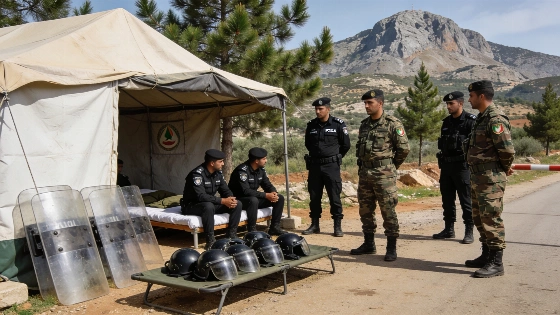
Local residents confirm the shift. One retired art teacher in Nador notes that the number of migrants in public spaces has dropped, and the city remains calm even during periods of heightened border tension. However, as one approaches Beni Enzar, the main crossing point to Melilla, the scale of Moroccan security operations becomes clear. Police and military checkpoints line the roads, and dozens of officers, some in camouflage and others in black uniforms, are stationed near the border. Temporary camps for security forces, complete with cots and riot gear, indicate overnight deployments in anticipation of possible mass crossings.
The increased security coincides with fears of new attempts to storm the border, often fueled by social media calls. Yet, on the day of the latest rumored attempt, no incidents occurred. Melilla remained quiet, with Spanish Guardia Civil monitoring key points along the perimeter, especially near the Dique Sur, a frequent site of previous crossings. The AMDH notes that Moroccan controls now extend far beyond the immediate border, with checkpoints on roads from Uxda and Fez aimed at intercepting young Moroccans heading north. The organization reports that over 80 Moroccan youths, including minors and two girls, have been detained in Nador and Beni Enzar since August 1, with some facing prison sentences for offenses such as public disorder and resisting authority. Drones and surveillance cameras are reportedly used to identify and arrest suspects, sometimes at their homes.
Those detained or intercepted are often transported by bus to distant regions within Morocco, sometimes hundreds of kilometers away, and left with minimal support. This approach mirrors previous tactics used against sub-Saharan migrants, effectively dispersing potential border crossers and reducing visible migration pressure near Melilla. The current situation stands in stark contrast to previous years, when Gurugú was a focal point of migration and border tension. For context, similar security measures have been implemented at other Spanish enclaves, as seen when Moroccan police blocked a mass attempt to enter Ceuta, resulting in dozens of arrests.
Melilla and Ceuta, Spain’s two autonomous cities in North Africa, have long been entry points for migrants seeking access to Europe. The dismantling of camps on Gurugú reflects a broader trend of intensified border enforcement and cooperation between Moroccan and Spanish authorities. While the visible presence of migrants has diminished, humanitarian organizations warn that the underlying challenges remain, with many forced into more precarious and hidden circumstances. The shift in migration patterns has also affected local communities, security operations, and the daily reality at the border, underscoring the evolving dynamics of migration in the region.