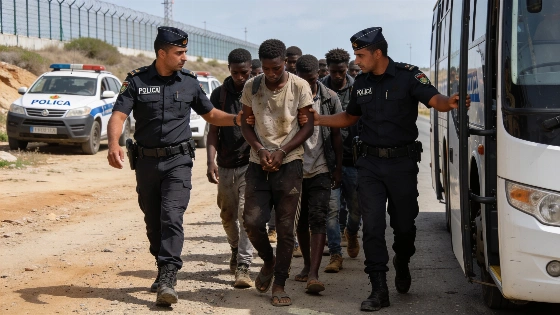
Moroccan forces stopped hundreds of migrants near Ceuta. Authorities detained 61 people for inciting illegal crossings. Security at the Spanish-Moroccan border has reached record levels.
Moroccan security forces intervened on Saturday to prevent a large group of mostly sub-Saharan migrants from crossing into the Spanish city of Ceuta. The operation unfolded near Castillejos, the Moroccan town closest to the border, where hundreds had gathered in hopes of reaching Spanish territory. Police moved in around midday, dispersing the group and detaining 111 migrants. According to Moroccan security sources cited by Efe, 61 individuals were arrested for allegedly encouraging illegal migration.
Authorities responded with a significant show of force, deploying additional police and military units to reinforce the border. Migrants intercepted near the Cerámica neighborhood were transported by bus to distant regions such as Uarzazat, over 800 kilometers from the Spanish border. The crackdown comes after the dramatic events of late July, when 80,000 people attempted to swim into Ceuta, overwhelming local resources and resulting in 141 deaths on both sides of the border, as reported by humanitarian organizations.
On Saturday, Ceuta awoke under a thick August fog and heightened uncertainty, fueled by viral social media messages in Morocco calling for a new mass crossing. The Spanish and Moroccan governments responded with an unprecedented security deployment, including a Moroccan police helicopter monitoring migrant movements outside Castillejos. The border area saw a marked increase in security personnel, with Spanish Army soldiers, legionnaires, and Civil Guard officers stationed at key points, especially around the El Tarajal breakwater. The fortification of this area was described as ten times stronger than the previous day.
Across the border, Moroccan police maintained a heavy presence, setting up checkpoints on main roads from Tetouan and Tangier. Surveillance intensified overnight, with rapid-response boats and drones patrolling both land and sea. One 17-year-old migrant who managed to reach Castillejos from Tetouan described passing through three police checkpoints along the 35-kilometer route, highlighting the scale of the operation.
Meanwhile, the Beni Ansar crossing in Melilla remained unusually calm, with Spanish passport control rooms nearly empty. Travelers noted delays in Moroccan passport checks, with some officers reportedly distracted by social media. Local businesses in Beni Ansar saw a sharp drop in customers, and the increased police presence was evident, especially near routes used by migrants attempting to swim to Melilla. Around 60 Moroccan officers, some in camouflage and others in black uniforms, were observed at one checkpoint, with part of the contingent staying overnight.
The once-notorious Gurugú mountain, previously a refuge for sub-Saharan migrants, now shows little sign of migrant encampments. Locals report that security controls have intensified since 2024, particularly in recent weeks. Military checkpoints now guard park entrances, and access to the mountain is tightly restricted. The area, a protected natural space, also hosts military-controlled zones, explaining the visible army presence and limited access. During a recent visit, no migrant settlements were seen on the slopes, marking a stark contrast to previous years.
This latest escalation in border security follows ongoing tensions between Spain and Morocco over migration and territorial issues. The situation remains volatile, with both countries deploying thousands of security personnel to prevent further mass crossings. The Partido Popular has previously criticized the Spanish government’s handling of relations with Morocco, especially after Rabat threatened to suspend extradition agreements over disputes involving Ceuta and Melilla, as detailed in recent coverage of diplomatic tensions.
Ceuta and Melilla, Spain’s two enclaves in North Africa, have long been focal points for migration from Africa to Europe. The border areas are among the most heavily fortified in the region, with double fences, surveillance technology, and frequent patrols. The recent surge in attempted crossings has prompted both governments to further tighten controls, reflecting the ongoing challenge of managing migration flows at Europe’s southern frontier. The situation underscores the complex interplay between humanitarian concerns, border security, and diplomatic relations in the region.