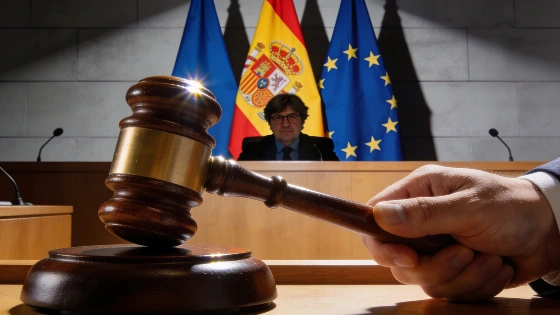
The EU Court of Justice has ruled that Spain's amnesty law does not breach European rules. This decision could impact cases against Catalan leaders and influence future Supreme Court actions.
The Court of Justice of the European Union (TJUE) has delivered a decisive ruling in favor of Spain's amnesty law, confirming that the legislation does not violate EU financial interests or anti-terrorism directives. The decision, issued in response to questions from Spain's Tribunal de Cuentas and the Audiencia Nacional, removes a major legal obstacle for Catalan independence leaders, including Carles Puigdemont, who have faced prosecution for their roles in the 2017 independence push.
Luxembourg judges found no grounds to argue that the amnesty law undermines the European Union's financial stability, even if a hypothetical secession could reduce Spain's gross national income. The court also dismissed concerns that the law constitutes a 'self-amnesty,' echoing the earlier opinion of the institution's Advocate General. The ruling comes after the law was passed under exceptional political circumstances, as a condition for ERC and Junts to support Pedro Sánchez's government, and without prior consultation with European judicial authorities.
For Puigdemont, the court's stance on the misuse of public funds is particularly significant. Spain's Supreme Court has maintained an arrest warrant against him, arguing that the amnesty does not apply to the charge of malversación (embezzlement) and that public money used during the independence process amounted to personal enrichment. Puigdemont's defense has consistently rejected this interpretation. The TJUE's decision now puts pressure on the Supreme Court, as many leaders of the procés have appealed to the Constitutional Court, claiming their fundamental rights are being violated by ongoing prosecutions.
In a separate but related matter, the EU court also addressed the application of the amnesty law to terrorism charges. This affects a group of activists from the Committees for the Defense of the Republic (CDR), who were prosecuted by the Audiencia Nacional for alleged terrorist activities linked to the independence movement. The judges concluded that the Spanish amnesty law does not undermine the effectiveness of the EU directive on combating terrorism, further strengthening the legal standing of the measure.
The ruling is expected to have a domino effect on pending cases, with independence leaders hoping it will compel Spanish courts to apply the amnesty more broadly. The debate over judicial independence and political influence in Spain's legal system remains intense, as highlighted in recent coverage of tensions between regional and national authorities. For example, disputes over regional funding and legal jurisdiction, such as those described in the ongoing conflict between Catalonia and Madrid over transport card funding, illustrate the broader context in which these legal battles unfold.
Spain's amnesty law was designed to address the fallout from the 2017 Catalan independence referendum and subsequent legal actions against its organizers and supporters. The TJUE's decision clarifies that, from a European legal perspective, the law does not breach the Union's core interests or its framework for fighting terrorism. This outcome may accelerate the resolution of high-profile cases and could influence future legislative approaches to regional conflicts within Spain. The Constitutional Court is now expected to move forward with its own decisions, which will be closely watched by all sides involved.