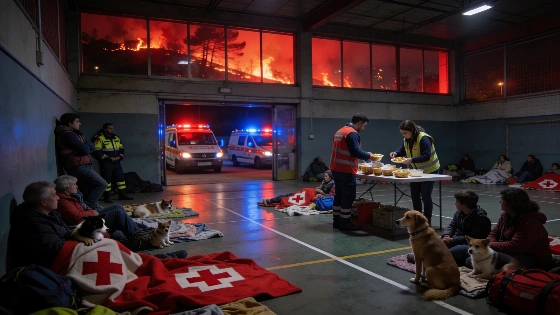
Hundreds in Cebreros and El Tiemblo spent the night in shelters as a major wildfire continues to threaten homes. Emergency crews battle shifting flames while residents await updates. Authorities urge caution as evacuations and confinements change rapidly.
Emergency shelters in Cebreros (Ávila) filled overnight as residents from El Tiemblo and surrounding areas sought safety from a wildfire that has burned unchecked for days. The fire, which began in Burgohondo, has already destroyed thousands of hectares and forced authorities to evacuate or confine multiple towns. As night fell, the municipal sports hall became a temporary refuge, with Red Cross blankets and volunteers providing food and support to those displaced.
Throughout the evening, the situation remained tense. The fire’s perimeter glowed red around Cebreros, with shifting winds and falling nighttime temperatures offering only brief opportunities for exhausted firefighters to contain the flames. Emergency vehicles and helicopters worked through the night, while residents watched anxiously from the shelter and nearby fields, uncertain whether the next flare-up would threaten their homes.
Inside the sports hall, a steady flow of volunteers prepared food for a diverse crowd: local families, elderly residents, children, emergency workers, and journalists. Many preferred to stay in the shelter rather than risk returning home, as updates about road closures, new evacuations, and shifting fire lines arrived sporadically. Some residents quietly shared their losses, from livestock to property, while others tried to distract themselves with conversation or their pets, who were also given space and care in the shelter.
As the night progressed, authorities advised Madrid residents to return to the capital to ease pressure on local resources, while those from El Tiemblo were told to either remain in the shelter or confine themselves at home. Older residents often chose to stay overnight in the sports hall, wary of sudden changes in the fire’s direction. Outside, some watched for new outbreaks, debating whether distant flames were the result of controlled burns by firefighters or new threats.
By late evening, controlled burns were underway near the cemetery, as firefighters took advantage of calmer winds to try to halt the fire’s advance. However, many sectors remained out of control, and emergency crews described the situation as “horrible” in brief messages. The shelter’s atmosphere alternated between relief when loved ones checked in and anxiety when news was scarce.
In the early hours, the shelter quieted as about 30 people tried to rest, undisturbed by the ongoing activity of emergency teams. Some residents, exhausted, slept wherever they could—on cots, in chairs, or even inside the goalposts of the sports hall. Volunteers from Protección Civil continued to provide food and drinks to new arrivals and emergency workers returning from the fire line. Occasional requests for medical assistance were handled quickly, and pets remained close to their owners throughout the night.
Despite the uncertainty, moments of solidarity and even affection emerged among those confined together. Couples comforted each other, and families held hands as they tried to sleep, united by the shared strain of the ongoing emergency. The fire’s unpredictable behavior and the complex terrain have made containment especially difficult, with authorities warning that the situation could persist for days.
This wildfire in Ávila is part of a broader pattern of severe fires affecting central Spain in recent years. Similar emergencies have forced mass evacuations in nearby regions, as seen when thousands were evacuated from Chapinería and neighboring towns due to fast-moving flames. Such incidents highlight the ongoing challenges faced by emergency services and residents as climate conditions contribute to more frequent and intense wildfires across the country.
Ávila’s rugged landscape, combined with high temperatures and shifting winds, complicates firefighting efforts. Local authorities continue to monitor the situation closely, issuing new evacuation or confinement orders as needed. For now, many residents remain in shelters, waiting for news and hoping for a break in the weather that will allow crews to bring the fire under control.