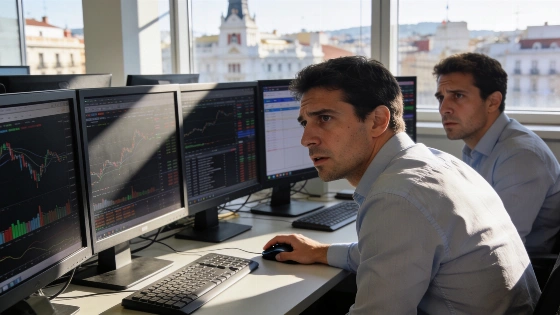
The Federal Reserve raised rates for the first time since 2023, sending shockwaves through Spanish markets. The IBEX 35 and euro both face renewed pressure. Investors brace for a day shaped by central bank decisions and key economic data.
Spanish markets opened on edge after the Federal Reserve raised interest rates by 25 basis points, moving its target range to 3.75%-4%. This is the first hike since 2023 and comes at a time when the IBEX 35 and the euro have already been under pressure from weeks of losses and global uncertainty. The Fed cited persistent inflation and strong labor market data as reasons for the move, and traders had largely expected the decision ahead of the meeting.
The IBEX 35 closed at 19,555.90 points on September 15, ending a month where the index dropped more than 2%. With trading yet to start for the day, investors remain cautious. The Fed's hawkish stance is likely to weigh on Spanish equities, especially banks and cyclical stocks, which are more sensitive to tighter financial conditions. Bolsa de Madrid notes that these sectors are particularly exposed during periods of aggressive monetary tightening.
Eurostat reported that core inflation in the eurozone reached 2.4% year-on-year in August, remaining above the European Central Bank's target.
Currency markets are also unsettled. The euro traded near 1.1534 against the dollar before the Fed's announcement, just above its monthly low. Institutional investors have increased their net short positions in euro futures, showing little faith in a quick rebound. The euro's weakness is made worse by the European Central Bank's own rate hikes, with the ECB raising its deposit rate to 2.50% as of September 10, 2026.
Eurostat is set to release August inflation data for the eurozone, with forecasts pointing to a 3.3% annual rate, up from 2.9%. This number will be closely watched by both policymakers and investors, as it could influence the ECB's next moves. Updated ECB projections show inflation averaging 3.0% in 2026, 2.5% in 2027, and 2.1% in 2028, suggesting the central bank will stay alert to price pressures.
In the UK, the Bank of England is preparing its own rate decision. Markets expect no change from the current 3.75%, but the central bank's tone remains cautious, keeping the British pound in focus and adding to the uncertainty for European assets. The Bank of England's Monetary Policy Committee says holding the rate steady reflects ongoing concerns about inflation in the UK.
Ahead of the Federal Reserve's decision, market-implied probabilities for a 25 basis point rate hike in the US reached as high as 90%, reflecting strong inflation and employment data. This heightened anticipation contributed to increased volatility across global markets.
In the US, two more data releases are expected: the Philadelphia Fed manufacturing index and weekly jobless claims. Both will shape expectations for further rate moves before the end of the year. BBVA Research notes that the Fed's latest projections now point to a more restrictive path than markets had expected, with a median PCE inflation rate of 3.7% for 2026 and GDP growth at 2.3%, partly due to investment in artificial intelligence. Unemployment is forecast to stay at 4.1% through 2029.
With a 50% chance priced in for another 25 basis point hike before year-end, investors in Spanish stocks, European bonds, and currency markets face a session marked by uncertainty. The combination of US monetary policy, eurozone inflation, and UK central bank decisions leaves little room for complacency.
As noted in a previous investigation, sudden changes in global policy can have immediate and sometimes unexpected effects on Spanish markets, making vigilance essential as new data and decisions emerge.
For now, investors and policymakers in Spain are left watching for the next move. With central banks showing no sign of easing and inflation still running high, Spanish markets are unlikely to see relief soon. The IBEX 35 remains vulnerable, the euro is weak, and uncertainty around global rates continues to shape the outlook for anyone exposed to Spain's financial sector.