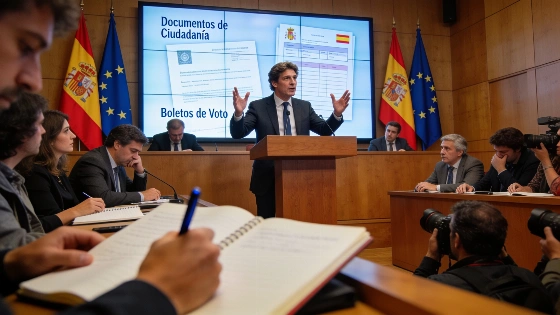
Alberto Núñez Feijóo accuses the government of manipulating the electoral roll through citizenship laws and immigration regularization. The opposition leader warns of the scale and management challenges for Spain.
Sharp criticism erupted in Castellón as Alberto Núñez Feijóo, leader of the Partido Popular, intensified his attack on the government’s approach to citizenship and immigration. Speaking at a party forum, Feijóo accused the executive of using what he called “social engineering” to alter Spain’s electoral landscape. He argued that recent measures, including the so-called ley de nietos and the extraordinary regularization of immigrants, could significantly reshape the country’s voter base.
Feijóo’s remarks focused on the ley de nietos, a provision under the Memoria Democrática law that grants Spanish nationality to individuals able to prove descent from Spanish citizens. According to Feijóo, this law could potentially add around 2.4 million people to the electoral register. He further linked this to the ongoing process of regularizing nearly 1.2 million immigrants and the estimated 4 million children of Spaniards born abroad, figures cited by the Partido Popular. In total, Feijóo warned that Spain could face an influx of up to eight million new citizens, a scale he claimed the state is unprepared to manage.
The opposition leader questioned whether the country had been adequately prepared for such a demographic shift, suggesting that the government’s motives were not as neutral as presented. He argued that these policies could have a direct effect on future elections, raising concerns about the integrity and capacity of Spain’s electoral system. Feijóo’s statements come amid a broader debate over the government’s handling of immigration and citizenship, with the Partido Popular framing the issue as one of electoral manipulation rather than humanitarian policy.
The controversy has also been fueled by Vox, the far-right party, which has called for the elimination of overseas postal voting and has echoed suspicions of potential electoral fraud. This has added further tension to the political climate, with both opposition parties challenging the government’s approach to expanding citizenship rights and managing migration flows.
Spain’s citizenship laws have evolved in recent years, with the ley de nietos aiming to address historical injustices by allowing descendants of exiles and emigrants to reclaim Spanish nationality. The extraordinary regularization process for immigrants is intended to address the status of long-term undocumented residents. However, these measures have become flashpoints in the national debate, especially as political parties link them to questions of electoral fairness and administrative capacity.
According to official data, Spain’s foreign-born population has grown steadily, and the country remains a key destination for migrants within Europe. The management of new citizenship applications and the integration of newcomers present ongoing challenges for public administration. As the debate continues, the government faces pressure to balance humanitarian commitments with concerns about electoral integrity and social cohesion.