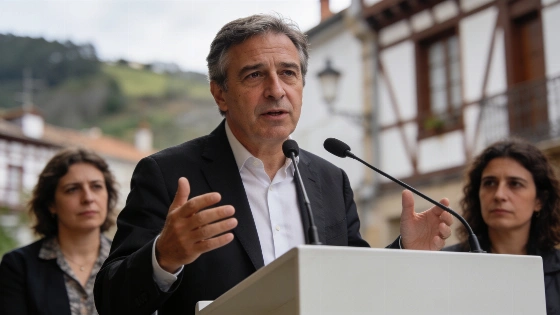
Alberto Núñez Feijóo used almost half of his 38 minutes and 10 seconds of speaking time to attack the government’s policies. Pedro Sánchez spoke for 37 minutes and 25 seconds, spending 11 minutes praising his government’s record, according to DatosRTVE’s analysis of the televised debate. Spain’s Television Academy organized the debate, held on 19 November, ten days before the 29 November general election. It was the first debate of the campaign and the candidates’ only head-to-head televised exchange.
The analysis classifies the candidates’ rhetoric as proposals or attacks, as well as defences and self-praise. Feijóo’s interventions were predominantly attacks; Sánchez more often promoted his administration’s record and defended it against criticism. The snap election was called before the end of the normal parliamentary timetable. Polling cited in contemporaneous coverage indicated that a PP and Vox combination could win a parliamentary majority.
Housing led the subject count, with both candidates spending about 14 minutes on it. Corruption took more than 12 minutes and featured more heavily in Feijóo’s contributions. Across the four subjects measured, the candidates spoke for 38 minutes and 47 seconds, or 51% of their combined speaking time of 75 minutes and 35 seconds. Those subjects were housing, corruption, immigration and taxation. Feijóo promised to build one million homes, while Sánchez defended eviction protections and rental-contract extensions. He urged Feijóo to retain Spain’s Housing Law, warning that repealing it would worsen the crisis. Feijóo proposed liberalizing land and expanding public-private cooperation, alongside lower taxes, particularly for young people. Sánchez argued that PP-led regional administrations had obstructed or failed to implement central-government housing measures.
Corruption accounted for 7 minutes and 4 seconds of Feijóo’s speaking time, nearly one fifth of his total. Sánchez devoted 14% of his time to the subject, making it his second-largest debate topic. Feijóo cited cases involving José Luis Ábalos. Santos Cerdán and Koldo García were also among the names raised. Sánchez acknowledged mistakes in trusting former collaborators. He said the PSOE had expelled people implicated in cases and cooperated with the courts. He also criticized corruption cases involving the PP and argued that the PSOE was Spain’s most transparent party.
On infrastructure and transport, Feijóo spoke for 7 minutes and 20 seconds about taxation or infrastructure and transport, compared with 2 minutes and 32 seconds for Sánchez. The railway tragedies at Adamuz in Córdoba and Urda in Toledo, which together killed 115 people, were among his targets. Feijóo referred to them 10 times. Two of Sánchez’s three references were defensive, and he apologized to victims’ relatives during the debate. Feijóo accused the government of negligence and criticized Sánchez for not attending the victims’ funerals. The candidates also argued over migration policy. Feijóo supported deportation centres approved by some European Union countries, while Sánchez opposed locating such centres outside the bloc. Feijóo described irregular arrivals in Ceuta as an “invasion”; Sánchez argued that migration contributes to Spain’s economic growth.
Sánchez used 57 of his 194 interventions to praise his government’s record, while about one in four of his interventions was a defence. Feijóo made more proposals in the debate’s detailed tally: 28, against 16 from Sánchez. RTVE gives a different Feijóo figure elsewhere in its analysis, counting 29 proposals. It does not explain the one-item difference. The 2023 televised encounter between Sánchez and Feijóo drew 5.9 million viewers, according to this earlier account.
Feijóo’s proposals included tax cuts, a zero social-security contribution for self-employed workers and a plan to build one million homes. On housing, Sánchez proposed rehabilitating properties and expanding protected housing. He also said the PSOE would protect pensions in the Constitution if it remained in government.
DatosRTVE’s figures come from a debate transcript divided into segments by topic and dominant rhetorical purpose. An artificial-intelligence model helped identify speakers and classify passages. RTVE journalists reviewed the classifications and made corrections. The broadcaster says it does not calculate a score or declare a debate winner.