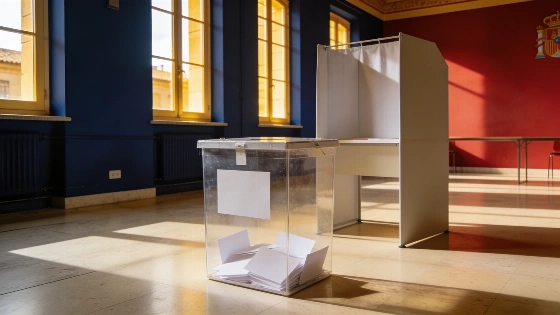
Polling stations are due to open from 09:00 to 20:00 on 29 November. Those hours set the window for calculating paid time off, capped at four hours and based on how long an employee’s shift overlaps with voting.
Less than two hours of overlap means no leave. Workers with between two and four hours of overlap receive two hours, while those with four to six hours receive three. An overlap of six hours or more qualifies for up to four hours. For reduced working hours, the allowance is adjusted proportionately.
The thresholds are clear in practice. Someone starting at 19:00 has no entitlement, while a shift from 17:00 to 23:00 qualifies for two hours. A part-time waiter working from 10:00 to 15:00 has five hours of overlap, equivalent to three hours before the proportional adjustment; at 50% hours, the allowance is one hour and 30 minutes. A shop assistant working from 09:00 to 20:00 can take the full four hours.
Millions of people in Spain work on Sundays. According to the National Statistics Institute (INE), around 4.64 million people worked at least one Sunday in 2025. The election campaign has also included debate over institutions, covered in a report on institutional renewal.
Employees cannot choose their own time slot: the company decides when they can take the leave, while accounting for work organisation. A residence, for example, may schedule voting leave after the breakfast shifts.
Workers away from their usual home, or facing circumstances that make it difficult to reach a polling station, may also take up to four paid hours during working time to request a census certificate in person and send their vote by post. The company may ask for proof of voting, which the polling station will issue on request.