Spanish Islands Tighten Car Entry Controls for Environment and Order. Several Spanish islands are introducing strict limits on car entry. Authorities are increasing controls to reduce traffic congestion and emissions. Violators face hefty fines.
Authorities on several Spanish islands have tightened entry rules for cars to curb traffic growth and protect the environment. The strictest measures are in place on La Graciosa (Canary Islands), where private cars are banned all year round — it is impossible to take personal vehicles there under any circumstances.
In the Balearic Archipelago, restrictions are introduced seasonally. On Ibiza, Formentera, and Menorca, a limit is set in summer on the number of vehicles allowed on each island at the same time. Formentera is subject to Law 7/2019 on 'sustainability', Ibiza to Law 5/2024 regulating traffic flow, and Menorca to Law 3/2023 on the biosphere reserve. Entering Formentera without a permit can result in fines of up to €10,000, and on Ibiza up to €30,000. Menorca planned to introduce a cap in 2026, but has since abandoned the idea.
Mallorca is also considering year-round restrictions. Since 2023, local authorities have been negotiating with ferry companies and car rental businesses to limit the influx of tourists arriving on the island with their own or rented vehicles. Under the draft law, residents are exempt from the new rules, while non-residents with property on Mallorca would be allowed to bring in only one car, provided taxes are paid on the island. Violations would be punishable by fines from €300 to €30,000. However, the initiative, proposed by Llorenç Galves, is currently on hold and is unlikely to come into effect in 2026.
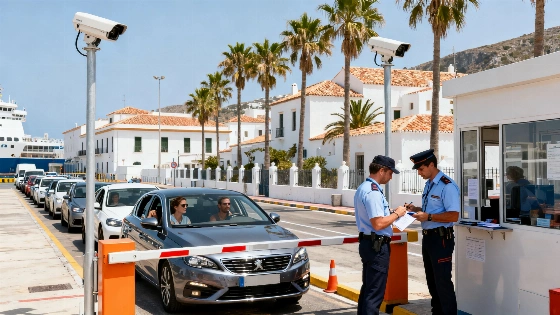
Entry is monitored by cameras recording license plates on key roads. The presence of an entry permit is checked—without it, access to the island is impossible. To obtain a permit, tourists are advised to apply in advance through special online services, as the number of permits is limited.
Restrictions on car entry have been introduced in response to the annual increase in tourist flow and the resulting traffic congestion. Authorities fear that without limits, the island's infrastructure will not cope with the load, and emission levels will continue to rise. As russpain.com notes, similar debates over balancing tourism and sustainable development are ongoing in other regions of Spain—for example, in Barcelona, the expansion of international flights is being discussed to support the economy (more on Barcelona's position).
For reference: The Balearic and Canary Islands are among Spain's most popular tourist destinations. During the summer season, the population of some islands multiplies several times over, leading to road congestion and increased air pollution. The introduction of transport limits aims to maintain a balance between the tourism economy and the quality of life for local residents.