Spain’s parties took their campaign across the country on Saturday, five weeks before the 29 November general election. In Palma, Vox leader Santiago Abascal warned of possible electoral tricks; Sánchez defended his anti-war position at the Reina Sofía.
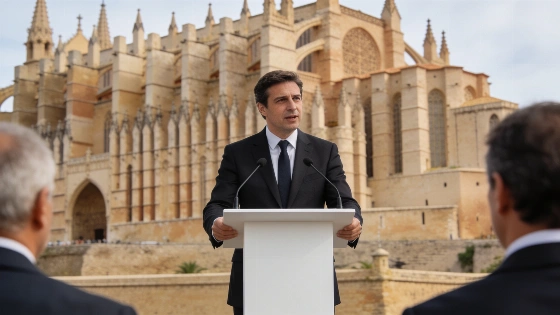
Outside Palma Cathedral, Vox leader Santiago Abascal urged supporters to remain on maximum alert for election day. He alleged that a desperate government could resort to violence. He also cited unusual political pacts and electoral tricks, warning that some might go undetected.
Abascal said the campaign had started badly, pointing to violence in A Coruña and Avilés before referring to Mahón. His Palma rally passed without incident under a substantial police security deployment. He had visited Menorca on Friday, where a protest took place against Vox’s presence. Vox said approximately 300 protesters approached the vehicle carrying Abascal and his team as they left the Menorca event, describing the incident as an attempted boycott.
The 29 November general election is five weeks away, and parties are holding rallies across Spain this weekend. The Spanish Government’s La Moncloa portal lists 38,728,356 eligible voters for the election to the Cortes Generales, comprising the Congress of Deputies and the Senate. A previous report on Senate coordination talks described discussions between PP and Vox over their Senate candidates. As of 23 October, those talks remained unresolved, with the deadline for filing definitive candidate lists approaching the following Monday. The parties were discussing coordination in response to a left-wing agreement to run jointly in the Senate.
Abascal’s Palma appearance was part of a wider tour that began on 20 October in Ponferrada, León, with stops planned across Castilla y León, Galicia, Asturias and the Balearic Islands, including A Coruña, Avilés, Burgos and Segovia. At the opening event, he criticised what he called weaknesses in the PP and warned supporters of a “dirty campaign, with traps.” On 24 October, he called for a “great majority” for Vox and said he was running for the presidency of the government, rather than seeking to serve as vice-president in a government led by Alberto Núñez Feijóo. Democrata reported that the PP had replaced nearly 60% of its heads of list for Congress compared with the previous general election.
In Granada, Pedro Sánchez contrasted what he called “la España de Lorca” with the cuts associated with Alberto Núñez Feijóo and the chainsaw associated with Abascal. Sánchez also posted a video from the Museo Nacional Centro de Arte Reina Sofía, standing before Pablo Picasso’s Guernica. He said Spain had held to the same principles on conflicts and rejected double standards.
The video drew criticism from the PP. Miguel Tellado, the party’s secretary general and campaign director, accused Sánchez on X of using public resources and the painting for a pre-campaign advertisement. Tellado said the privilege would end after the election, but did not address the substance of Sánchez’s message. Cayetana Álvarez de Toledo also condemned the video and said Picasso would have been appalled by the use of Guernica.
In Barcelona, Gabriel Rufián and Irene Montero held their first joint event as ERC and Podemos opened their campaign. They accused Feijóo of wanting a country in which women were enslaved. The coverage also includes a map of how the electoral system affects the alternative left and an Ignacio Escolar article titled “Una coalición con la ultraderecha para incumplir la Constitución”.
Javier Milei again attacked Sánchez during the annual Fundación Faro dinner, calling him corrupt. Milei also criticised Spain’s migration policy and the Ley de Memoria Democrática, claiming citizenship was being granted so new citizens would vote for the left, according to EFE.
The Ministry of Foreign Affairs said it had reinforced consular staffing after the Supreme Court required it to provide the identities of 163,020 people affected by the ley de nietos before 28 October. The ministry approved requests for additional staff and made embassy personnel available to the consulates.