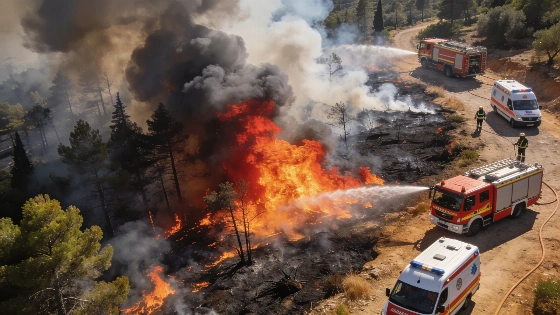
Firefighters in Girona are on alert as high temperatures and shifting winds threaten to reignite the La Bisbal d’Empordà wildfire. The blaze, which has damaged homes and forced emergency responses, remains a concern for local authorities.
Firefighters in Girona are maintaining heightened vigilance as the La Bisbal d’Empordà wildfire, which has already scorched around 2,200 hectares, remains a threat due to forecasted intense heat and unpredictable winds. Despite stabilizing the fire late Saturday, emergency teams are not yet ready to declare it under control, citing the risk of renewed outbreaks as temperatures rise and wind conditions shift throughout the day.
According to Mari Muñoz, subinspector of the Bombers de la Generalitat, 184 personnel, 40 vehicles—including 25 water trucks and 15 command units—and two aerial resources are currently deployed to monitor and secure the 40-kilometer perimeter. Their focus remains on active hotspots, particularly in the interior of Les Gavarres, where the terrain complicates efforts and the risk of flare-ups persists. Muñoz emphasized that the right flank, stretching toward Girona, is especially challenging due to its irregular boundaries and the influence of the sea breeze, which could exceed 30 kilometers per hour and potentially intensify the situation.
Overnight, a new ignition occurred in the Mas Ambrós urbanization in Calonge, but was swiftly contained by ground teams. The incident underscores the ongoing volatility of the fire, as even minor changes in weather can quickly escalate the threat. The firefighting strategy relies on rapid aerial response to any visible smoke columns, aiming to prevent further spread before conditions worsen.
Damage assessments reveal that eleven homes have been completely destroyed, with another fourteen partially affected. The impacted properties are located in Cruïlles, Monells i Sant Sadurní de l’Heura, La Bisbal, and residential areas of Calonge and Santa Cristina d’Aro. Since the fire broke out on Friday, the Catalan emergency medical service (SEM) has treated 14 individuals for fire-related incidents.
Authorities remain cautious, noting that while the current wind—known locally as marinada—is not as forceful as the tramuntana that initially fueled the fire’s rapid expansion, the ongoing heatwave could amplify its effects. The decision to declare the fire under control will depend on how conditions evolve throughout the day and whether new flare-ups can be prevented.
This latest development follows a series of emergency measures in the region, including lockdowns and evacuations, as detailed in a recent report on how the La Bisbal d’Empordà wildfire forced several towns to take urgent action: see the full story on the earlier emergency response.
Wildfires are a recurring challenge in Catalonia, particularly during periods of extreme heat and drought. The region’s varied terrain and dense vegetation can complicate firefighting efforts, making rapid response and coordination between ground and aerial units essential. In recent years, authorities have increased investment in early detection systems and public awareness campaigns, but the combination of climate factors and human activity continues to pose significant risks. The current situation in Girona highlights the ongoing need for vigilance and preparedness as Spain faces longer and more intense fire seasons.