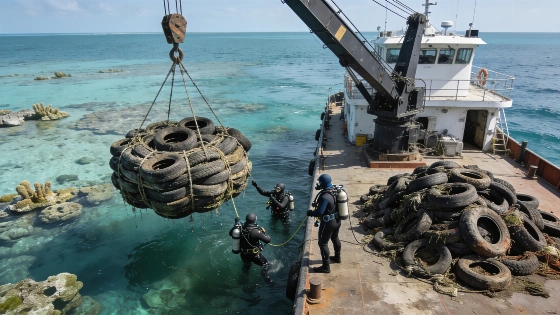
More than half a million tires have been pulled from the Osborne Tire Reef off Florida, but over 500,000 remain visible on the seabed. The state now estimates it will take until 2038 and $137 million to fully remove the tires and restore damaged coral habitats.
In the waters off Fort Lauderdale, Florida, a well-intentioned experiment from the 1970s has become a costly environmental headache. The Osborne Tire Reef, once promoted as a way to create new marine life by dumping up to two million used tires into the ocean, is now the focus of a massive cleanup effort expected to cost $137 million and stretch over the next 14 years.
According to the latest state figures, 535,676 tires have been removed from the authorized area as of the end of 2025. Yet a 2024 survey still counted 521,000 visible tires scattered across the seabed, not including those buried beneath sand or outside mapped zones. The original project, led by Broward Artificial Reef Inc. with state and federal approval, began in 1972. Early records show 50,000 tires were dumped in April 1972 and another 190,000 in November 1973, but incomplete documentation means the true total could be as high as two million.
From Solution to Problem
The tires were bundled with plastic straps and metal clips, but saltwater quickly corroded the metal and waves tore the bundles apart. Over decades, storms and currents scattered the tires, sending them crashing into natural reefs and damaging fragile coral. Instead of fostering marine life, the project created a sprawling field of debris that now threatens the very habitats it was meant to help.
Florida's Department of Environmental Protection has deployed sonar, GIS mapping, and commercial divers to locate and extract the tires. Divers group the tires, attach lift bags, and haul them to boats equipped with cranes. Each trip can remove up to 300 tires, which are then transported to Port Everglades for processing or recycling. Military teams have already helped extract more than 72,000 tires, but the scale of the problem remains daunting.
Restoration Challenges
Every tire in contact with coral must be carefully checked. If live coral is found, divers must relocate the colony before moving the tire, a process that slows progress and increases costs but is essential to avoid further ecological harm. Florida officials acknowledge that some tires may be left in place if removal would cause more damage than leaving them undisturbed.
The 2024 restoration plan estimated 429,000 tires lying on sandy seabeds and 92,000 touching reef structures. The state aims to remove 945,804 tires from the authorized area by 2033, but this figure does not represent a full recount of all tires present. The cleanup is complicated by other environmental pressures, such as sargassum blooms that can also harm coral reefs, but in Osborne, the main threat remains the physical impact of the tires themselves.
Long Road Ahead
The full removal and restoration effort is projected to last through the 2037-2038 fiscal year, provided funding and contracts remain in place. Of the estimated $137 million cost, about $78 million is allocated for tires on sand, $19 million for those on reefs, and $40 million for biological restoration. Annual spending is expected to range from $6 million to $13 million. In September 2025, Florida signed a contract specifically targeting tires that directly damage the reef, with work scheduled through September 2032.
The Osborne Tire Reef stands as a cautionary tale of unintended consequences. What began as a recycling initiative has become a multi-generational environmental and financial burden. The official Osborne Reef project page compiles reports and historical documents, while the 2024 restoration plan details the budget, methods, and timeline. For comparison, other ambitious ecological interventions have also faced scrutiny, such as the widely circulated but unsubstantiated claims about tortoises greening the Sahara, which were examined in this recent analysis.
As Florida continues its painstaking removal of the tires, the project highlights the risks of large-scale environmental engineering and the long-term costs of well-meaning but poorly planned interventions.