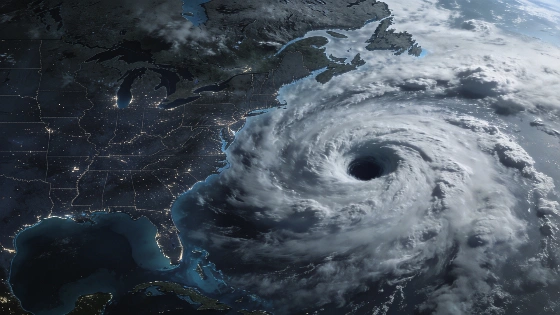
A private weather service expects a strong hurricane to threaten New England in 2026. This contrasts with official forecasts of a mild season. The risk is highest for the New York-New England coast.
A new forecast from National Weather Forecasting (NWF) has raised concerns about the 2026 Atlantic hurricane season, highlighting a significant risk for the New York and New England coastline. While most established meteorological centers, including Colorado State University, expect a quiet year with few major storms, NWF maintains that the threat of a powerful hurricane remains high for the region.
NWF, which recently acquired the Global Weather Oscillations (GWO) service, stands apart by not only predicting more named storms than its competitors but also by specifying where the most severe impacts could occur. According to the company, there is a 33% probability that a major hurricane will strike the New England area this season—an estimate that sharply contrasts with the subdued outlooks from other forecasters.
The forecast is based on long-term climate cycles and gravitational data, a methodology developed by Florida meteorologist David Dilley, whose work has attracted a dedicated following among certain insurers and event planners. Dilley argues that the current global cooling phase could create conditions similar to those that led to the devastating 1938 hurricane, which caused extensive damage and loss of life in New England.
Russ Murley, president of NWF and a veteran meteorologist, notes that the company’s approach offers more detailed regional risk assessments than traditional forecasts. For 2026, NWF’s analysis singles out Zone 1—which includes New England—as facing the highest risk, while the Gulf Coast from Alabama to Texas is assigned a lower, 20% chance of a major hurricane. Other coastal areas are considered less likely to experience significant storms this year.
Unlike most public forecasts, NWF’s detailed regional predictions are available only to subscribers, with prices ranging from $350 to $2,500 depending on the level of detail. The company claims a 75% accuracy rate for its hurricane landfall forecasts over the past two decades, though not all predictions have materialized. For example, a major hurricane predicted for Florida’s west coast last year did not occur, but the service did correctly anticipate Hurricane Irma’s path in 2017 when others did not.
NWF’s recent acquisitions, including Metro Weather Service and a New York-focused company, have expanded its capabilities in long-range and venue-specific forecasting. The firm now provides tailored weather analysis for sports venues and infrastructure projects, offering granular data that can be critical for planning and risk management.
For context, the 1938 hurricane referenced by NWF remains one of the most destructive storms in New England’s history, resulting in over 680 fatalities and property losses equivalent to more than $2 billion today. While the likelihood of a similar event is still a matter of debate among meteorologists, the divergence in forecasts for 2026 underscores the challenges of long-range hurricane prediction and the importance of regional preparedness.
In the United States, hurricane season typically runs from June to November, with the Atlantic basin seeing an average of 12 named storms per year. Advances in forecasting have improved warning times and risk assessments, but significant uncertainty remains, especially for rare but high-impact events. The contrasting predictions for 2026 highlight the need for ongoing vigilance along the U.S. East Coast, particularly in areas that have not experienced a major hurricane in decades.