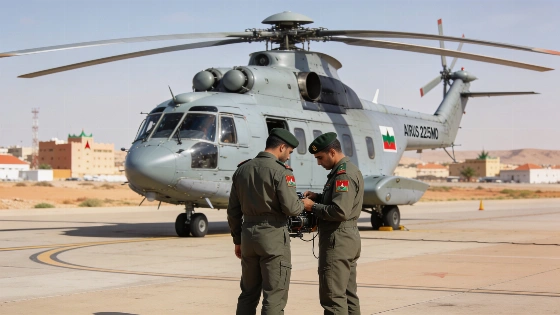
Morocco has placed a significant order for Airbus Caracal helicopters, with contracts exceeding €1.3 billion in the past decade. The deal highlights growing military cooperation and advanced technology transfers.
Morocco has finalized a substantial order for H225M Caracal helicopters from Airbus, as confirmed by the French Ministry of Defence in its latest annual report to the National Assembly. The cumulative value of Moroccan contracts for these military helicopters has surpassed €1.325 billion over the last ten years, with more than €532 million accounted for in the most recent year alone.
The H225M Caracal, developed by Airbus Helicopters, is recognized for its versatility and operational reliability in demanding environments. The Royal Moroccan Armed Forces have chosen this model for its proven performance in international missions, including deployments in Afghanistan, Chad, Mali, and Somalia. The Caracal’s track record of over 300,000 flight hours underlines its reputation among military operators worldwide.
Equipped with two Safran Makila 2A1 engines and a dual digital control system (FADEC), the Caracal achieves a top speed of 324 km/h and an operational range of 920 kilometers. Its advanced dynamic systems and robust engine design ensure high reliability and adaptability for a range of missions.
The helicopter’s cabin can accommodate up to 28 fully equipped soldiers or carry external loads exceeding four tonnes. Its modular interior allows for rapid reconfiguration, supporting tactical transport, special operations, medical evacuation, and search and rescue missions. In medical roles, the Caracal can be fitted to transport 11 stretchers with a complete medical team, enhancing its value for humanitarian and emergency response scenarios.
Operational flexibility is further enhanced by anti-icing systems and full compatibility with night vision goggles, enabling safe flights in adverse weather and low-visibility conditions. The Caracal is also fitted with advanced crew protection, including shock-absorbing seats and a comprehensive self-defense suite. This includes early warning sensors, laser systems, and the option to mount automatic machine guns at side windows for direct fire support during high-risk landings or evacuations.
According to Hespress, these features make the Caracal a preferred choice for complex tactical operations. The ongoing investment in such advanced military technology reflects Morocco’s commitment to modernizing its armed forces and strengthening its operational capabilities.
This development comes amid broader regional security concerns and evolving defense partnerships. For context, recent tensions in North Africa, such as the migration crisis in Ceuta, have drawn attention to the strategic importance of military readiness and cooperation between European and North African states. The Spanish government’s response to these challenges, including calls for royal intervention, was previously discussed in an analysis of the political pressures surrounding the Ceuta border situation.
The Caracal’s adoption by Morocco is part of a wider trend of modernization among North African militaries, often involving European defense manufacturers. The H225M’s ability to perform in diverse operational theaters, from combat to humanitarian missions, positions it as a key asset for Morocco’s evolving defense strategy. As military procurement continues to shape regional dynamics, such contracts highlight the intersection of technology, security, and international cooperation in the Mediterranean area.