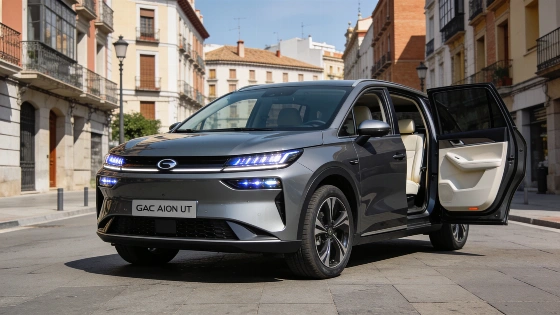
The GAC Aion UT enters Spain with a striking look, a roomy interior, and a 60 kWh LFP battery. Priced to challenge established players, it promises more space and equipment than many competitors in its segment.
Spain’s electric car market just got a jolt. The GAC Aion UT has landed with 204 horsepower, a 60 kWh LFP battery, and a price just under €31,000. This isn’t a routine launch. GAC is taking aim at both European and Chinese rivals, betting that buyers want more space, sharper design, and better value.
GAC didn’t just ship in another model. The Aion UT was designed in Milan and built at Magna Steyr’s plant in Austria. That’s a clear signal: this car is tuned for European drivers. It measures 4.27 meters long, almost identical to the Volkswagen ID.3 Neo. But the Aion UT stands out. Its two-level front, bold LED lights, and semi-flush door handles give it a modern, aerodynamic look. The rear is more reserved, with squared lights and a simple tailgate. Not everyone will love the back. Some will want more flair.
The Aion UT was awarded Best Exterior Design at the 2026 Torino Automotive Design Award, highlighting its Milan-based development and rapid expansion across multiple European markets.
Step inside and the Aion UT makes its case. The cabin feels bright and open. Front seats adjust electrically, though there’s no lumbar support. A digital instrument cluster sits next to a big 14.6-inch touchscreen. Materials mix textured plastics with synthetic leather. The floating center console hides clever storage: a split armrest and a secret compartment for valuables. GAC counts 24 storage spots in the cabin. The rear seats impress. There’s a flat floor, lots of legroom, and a wide glass roof. Space like this is rare in a compact EV.
The boot is practical too. It holds 440 liters—much more than the Volkswagen ID.3’s 385 liters, and even more than some bigger cars. There’s a double floor and side pockets for extra storage. But there are no hooks or tie-downs. That’s a miss. The rear bench folds 60/40. The front passenger seat folds flat as well. Long items fit with no trouble.
The battery is a highlight. The Aion UT uses an LFP pack: 62 kWh gross, 60 kWh usable. It’s built for regular 100% charging and should last longer than some other chemistries. Official WLTP range is 430 km. In the city, GAC claims 620 km. Real-world numbers are lower. Early tests show about 300 km on the motorway and just over 200 km between fast charges. That’s based on a measured 19.8 kWh/100 km in mixed driving.
According to several independent sources, GAC has established a dedicated European operational structure: design is handled in Milan, assembly takes place at Magna Steyr in Austria, and spare parts logistics are managed through Rotterdam. This approach demonstrates GAC's commitment to a long-term presence in Europe, rather than simple export from China.
Charging speed is where the Aion UT falls behind. DC fast charging peaks at 87 kW. It takes 32 minutes to go from 10% to 80%. The charging curve stays flat and steady, but some rivals, like the Leapmotor B05, charge faster. At home, the 11 kW AC charger fills the battery overnight if you have three-phase power.
Óscar Magro’s driving review points to a well-rounded car. The 204 hp front motor gives quick acceleration—0 to 100 km/h in 7.3 seconds. The suspension balances comfort and control. Steering weight can be adjusted, but it’s not especially sharp. Build quality is solid for the price. No rattles. No loose panels. It’s honest engineering.
Even the base Premium trim comes loaded: heated front seats, a 360-degree camera, adaptive cruise, a heat pump, and V2L external power. The Luxury version adds an electric tailgate, folding mirrors, an auto-dimming rearview mirror, and a ventilated driver’s seat for €1,000 more. Buyers should check specs at the dealership. Published equipment lists have changed more than once.
But the Aion UT faces tough competition. The Leapmotor B05 starts at €23,775 for a 56.2 kWh, 218 hp model. That’s €7,220 less than the Aion UT Premium. The B05’s interior and boot are smaller, but its price is hard to beat. The Volkswagen ID.3 Neo starts at €35,491. The Aion UT sits right between the budget upstart and the established European.
GAC’s promotional pricing needs a closer look. The advertised €22,945 price only applies if you finance the full amount over 60 months at 10.99% TIN and 11.56% TAE, plus a €4,050 government grant. With interest, you pay €29,925.82 in total. The offer runs until September 2026. Buyers should read the fine print and negotiate. Real-world deals may be better than the official list.
Safety is a draw. Both the Aion UT and Leapmotor B05 have five-star Euro NCAP ratings. The GAC scores 91% for impact protection, the B05 scores 92%. Families get ISOFIX mounts on both rear seats and the front passenger seat. The anchor covers aren’t the best, but the mounts are there.
For more on the Aion UT’s launch and its plans in Spain, see the earlier breakdown.
The GAC Aion UT isn’t a revolution. It’s a straight shooter. Space, comfort, and equipment are all strong. The battery works for daily use and moderate trips. Charging speed is its weak spot. Price is competitive, but rivals like Leapmotor are pushing hard. Still, the Aion UT’s mix of European design, practical features, and real-world usability makes it a serious contender. The real test comes when Spanish buyers put it up against its rivals. For now, GAC has sent a clear message. The era of bland, overpriced electric compacts is ending.