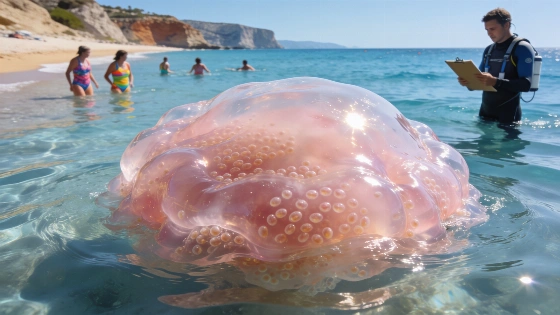
A massive, shimmering gelatinous structure was spotted floating near Velilla Beach in Granada, Spain. Identified as a diamond squid egg mass, the rare find has surprised both beachgoers and marine biologists with its size and biological significance.
Just 50 meters from the shoreline at Velilla Beach in Almuñécar, Granada, a striking pinkish, iridescent mass measuring around 60 centimeters long and 20 centimeters in diameter was discovered floating in the water. The unusual sight immediately drew the attention of swimmers and scientists alike, prompting questions about its origin and purpose.
Marine biologist Luis Sánchez Tocino was among the first to document the find on June 9. After close examination, the structure was identified as an egg capsule of the diamond squid, known scientifically as Thysanoteuthis rhombus. This species is rarely seen so close to the coast, making the event particularly noteworthy for researchers.
Unusual Reproductive Strategy
Unlike many cephalopods that attach their eggs to rocks or seaweed, the diamond squid releases its eggs in large, free-floating gelatinous masses. These cylindrical capsules can contain up to 70,000 embryos, all protected within the jelly-like structure as they develop. The mass drifts near the surface, carried by ocean currents, offering a unique form of shelter until the eggs hatch.
The presence of such a reproductive mass so close to a popular swimming area is highly unusual. Typically, diamond squid inhabit open, tropical and subtropical waters, rarely venturing near continental shelves or beaches. Their reproductive behavior, combined with their preference for deeper waters, means that sightings like this are exceptional along the Spanish coast.
Scientific Context and Rarity
Previous records of diamond squid egg masses in the western Mediterranean and Canary Islands are scarce. A study published in the Journal of Plankton Research documented only eight such observations between 1995 and 2000, all floating near the surface and ranging from 80 to 130 centimeters in length. The Almuñécar specimen, though slightly smaller, displayed all the characteristic features: elongated shape, gelatinous texture, pinkish hue, and a dense concentration of eggs.
Experts caution against interpreting this event as a sign of sudden ecological change or species invasion. Instead, it offers a rare opportunity to better understand the sporadic presence of diamond squid in the region and to study their reproductive habits in situ.
Advice for Beachgoers
Authorities and marine specialists advise anyone encountering a similar gelatinous mass in the sea not to touch or remove it from the water. Despite its unfamiliar appearance, such a structure is extremely fragile and vital for the development of thousands of embryos. Disturbing or breaking the mass can destroy the next generation of this elusive species. The recommended action is to keep a safe distance, observe without interference, and notify local experts or lifeguards for proper assessment.
About the Diamond Squid
The diamond squid is named for its distinctive rhomboid-shaped fins, which cover much of its mantle and give it a unique silhouette. Individuals can reach up to 130 centimeters in mantle length and weigh as much as 30 kilograms, though they should not be confused with the much larger deep-sea giant squids. Their elusive nature and preference for open waters make direct encounters rare, especially so close to shore.
This discovery at Velilla Beach highlights the hidden complexity of marine life just beyond the sand, reminding both scientists and the public that remarkable biological events can unfold within sight of everyday coastal activity.