Ceuta’s migrant crisis has triggered a wave of criticism from police, judges, the PP, and the EU. Authorities demand faster expulsions and more resources. The government insists reinforcements are underway.
The Spanish government is under intense scrutiny as the migrant situation in Ceuta escalates, with demands for urgent action coming from police unions, the judiciary, the Partido Popular (PP), and the European Commission. Calls for rapid expulsions and increased resources have grown louder, while local officials accuse Madrid of leaving Ceuta to manage the crisis alone. Despite these accusations, the Ministry of Inclusion has agreed to create new accommodation for 1,500 migrants, aiming to prevent people from sleeping on beaches or wandering the city without support.
Political pressure has sharpened, especially after the influx of thousands of migrants at the end of July. The PP’s Cuca Gamarra and Ceuta’s president Juan Jesús Vivas have both insisted that the government must expel all irregular arrivals from 30 and 31 July, arguing that Morocco is using migration to challenge Spanish sovereignty. Alberto Núñez Feijóo’s planned visit to Ceuta is expected to further intensify the debate, as he accuses the central government of failing to protect local residents and national interests.
However, the government points out that the situation is more complex than critics suggest. While most of the estimated 80,000 migrants who entered Ceuta during the crisis returned to Morocco within hours, around 9,000 remain. Authorities must process asylum requests and determine eligibility before any expulsions, a process complicated by legal protections—especially for minors. The European Commission has publicly supported the return of all irregular minors to Morocco, reflecting a tougher EU stance on migration, but Spanish law requires careful assessment to avoid legal violations, as highlighted by past court rulings against rushed deportations.
On the ground, tensions are rising among both migrants and residents. Some migrants, frustrated by uncertainty and poor conditions, have staged hunger strikes to demand asylum, even though such requests are rarely granted for Moroccan nationals. Residents express growing concerns about safety, with reports of families staying indoors and police unions citing a spike in emergency calls, thefts, and violent incidents. Police representatives warn that the atmosphere is volatile and urge restraint to prevent further escalation.
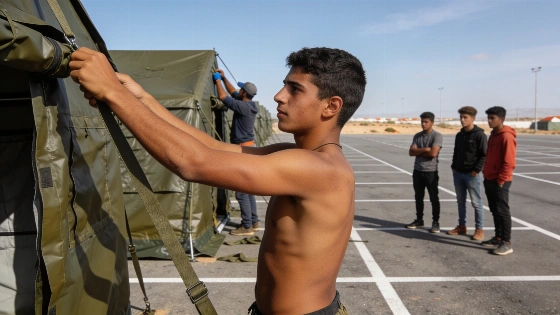
Efforts to set up new shelters are progressing slowly. The most visible changes are near the border, where military tents have been erected in a parking area usually reserved for vehicles crossing into Morocco. Workers on site say they are unsure whether the facilities will house adults or minors, and uncertainty prevails among the migrants themselves. Other planned sites, such as the former cavalry barracks and the city’s equestrian center, have sparked protests from local residents, who argue that temporary shelters are not a real solution and fear they will attract more arrivals.
Police unions have amplified their criticism, citing a surge in crime and a lack of government foresight. The Sindicato Profesional de Policía (SPP) and Sindicato Unificado de Policía (SUP) report increased incidents, including assaults and robberies, while the Asociación Unificada de la Guardia Civil (AUGC) laments the impact on community life. The government responds by highlighting official measures already taken, such as reinforcing the local court with additional staff and increasing the capacity of the Institute of Legal Medicine by 271%. Three substitute prosecutors and five new legal aid lawyers have also been assigned to Ceuta.
This standoff between national authorities and local actors reflects the broader political and institutional strain caused by the crisis. As noted in recent coverage of Ceuta’s ongoing challenges, the debate over responsibility and solutions remains unresolved, with each side pointing to the other for action.
Ceuta’s unique position as a Spanish enclave bordering Morocco has long made it a focal point for migration into Europe. The city’s population of around 80,000 faces recurring pressures from sudden influxes, and the legal framework governing asylum and deportation is shaped by both Spanish and EU law. The government’s current approach seeks to balance humanitarian obligations with public order, but the situation remains fluid. The outcome of this crisis may influence future migration policy across Spain and the EU, as well as relations with Morocco. For now, the city continues to grapple with uncertainty, political tension, and the practical challenges of managing a large migrant population under intense public scrutiny.