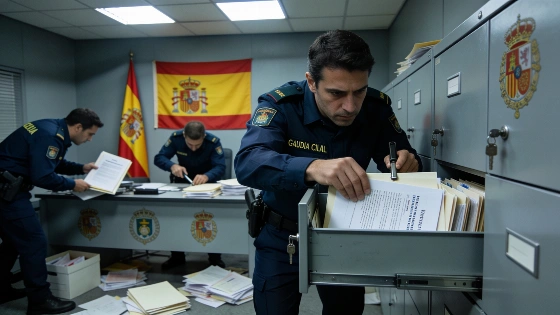
A single, undisclosed copy of sensitive disciplinary files targeting agents investigating cases linked to Pedro Sánchez's family was discovered locked in a senior Guardia Civil official's office. The incident has triggered judicial scrutiny and raised concerns over document handling.
Spain's Guardia Civil is under intense scrutiny after the Unidad Central Operativa (UCO) uncovered the only existing copies of two confidential disciplinary files in the locked office of the DAO, Manuel Llamas. These files targeted agents investigating judicial cases involving the family of Prime Minister Pedro Sánchez, a situation described by internal sources as a serious breach of official document protocols.
The discovery took place on May 27, when UCO officers, led by Lieutenant Colonel Antonio Balas, arrived at the Guardia Civil's headquarters in Madrid to retrieve the files. Their search through various departments proved fruitless until it was finally acknowledged that Llamas kept the original documents in his private office, secured and undigitized. No other copies or records existed elsewhere in the institution, according to sources cited by EL ESPAÑOL.
Judicial sources highlight that this irregular custody points to an unusual level of personal interest from the DAO in the agents handling politically sensitive investigations. The files in question were opened against UCO officers involved in cases affecting the PSOE and the prime minister's family circle. The lack of transparency and proper registration has raised alarms about the integrity of internal oversight within the Guardia Civil.
Shortly after the UCO's intervention, government sources suggested that Balas and his team had overstepped by entering Llamas's office. However, the operation was conducted under a judicial order from Judge Santiago Pedraz, who is investigating both Llamas and the director of the Guardia Civil, Mercedes González, for alleged misconduct and obstruction of justice. Both officials are scheduled to testify in court on July 16.
The files were reportedly initiated after Llamas ordered a preliminary inquiry on December 4, 2024, to determine if UCO agents had committed disciplinary infractions. One focus was the inclusion of the prime minister's wife's email address in a UCO report, as part of the investigation into David Sánchez, the prime minister's brother. These actions coincided with meetings between Mercedes González and Leire Díez, a key PSOE operative, who, under the guidance of former party secretary Santos Cerdán, allegedly coordinated efforts to discredit UCO investigators, judges, and prosecutors.
According to case documents, meetings between González and Díez took place on September 30 and December 20, 2024, and April 2, 2025. During the last meeting, Díez reportedly offered incentives to Commander Rubén Villalba, implicated in the Koldo case, in exchange for information against UCO investigators, particularly targeting Balas.
On April 29, 2025, the Guardia Civil's Information Headquarters issued a memo warning of a coordinated campaign to undermine UCO's credibility, explicitly naming Díez and linking the strategy to Cerdán and González. A similar note was produced by the UCO on May 6 and delivered to General Alfonso López Malo, who then discussed it with Llamas. Notably, Anticorrupción prosecutors claim Llamas withheld the original memo for ten days, despite its relevance to ongoing investigations.
López Malo's concern over the situation led to the implementation of counter-surveillance measures around two UCO officers identified as targets. Llamas also informed López Malo that he had already briefed González on the Information Headquarters' findings. Despite being aware of the campaign, González reportedly continued to communicate with Díez, including on May 11, 2025, when sensitive WhatsApp messages between former minister José Luis Ábalos and Pedro Sánchez surfaced in the press. González activated auto-delete on her chat with Díez that same day.
On May 29, 2025, González met with Llamas, López Malo, UCO chief Rafael Yuste, and Balas, without disclosing her prior contacts with Díez. Prosecutors have expressed doubts about González's recent testimony before the Senate's investigative committee, citing inconsistencies with documented evidence.
This case highlights ongoing tensions within Spain's law enforcement and political spheres regarding the handling of sensitive investigations. The controversy over document custody and alleged attempts to influence or discredit judicial police work echoes broader concerns about institutional transparency and accountability. Similar disputes over official conduct and legal oversight have surfaced in other Spanish regions, as seen when Compromís considered legal action against Vicent Mompó following a court dispute.
In Spain, the Guardia Civil operates as a national law enforcement agency with both military and civilian functions. The DAO (Deputy Operational Director) is a senior position responsible for operational oversight. The UCO specializes in complex criminal investigations, often involving political or economic corruption. The current case underscores the challenges faced by internal watchdogs when their work intersects with high-level political interests. As the judicial process unfolds, the outcome may set important precedents for the management of sensitive files and the independence of police investigations in Spain.