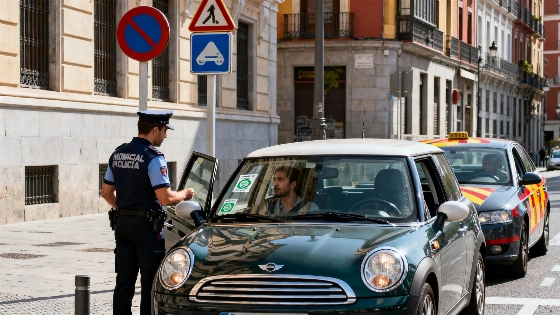
Madrid drivers face €200 fines for using certain lanes alone. The Guardia Civil enforces new rules requiring at least two occupants per vehicle. The measure aims to ease urban congestion but has triggered strong reactions.
Madrid’s main access roads are now under stricter surveillance as the Guardia Civil enforces a €200 fine for drivers traveling alone in designated lanes. The new rule, introduced to combat urban congestion, requires at least two occupants per vehicle on specific stretches of the A-6 and A-2 highways during peak hours. The measure has already provoked frustration among motorists, many of whom argue that they should have the freedom to decide how many people travel in their own cars.
The Dirección General de Tráfico (DGT) has expanded its catalogue of road signs to mark these restricted lanes. In Madrid, the A-6’s Bus Vao lane and a reserved lane on the A-2 between Alcalá de Henares and the city center now display the new signage. These lanes, previously accessible to hybrid and electric vehicles regardless of occupancy, are now off-limits to solo drivers—even those with “Etiqueta Cero”—when traffic is heavy. The DGT monitors compliance using cameras, and violations are automatically processed.
On the A-6, the Bus Vao lane operates with dynamic rules, allowing vehicles with at least two occupants to use it at certain times, depending on traffic flow. The A-2’s reserved lane, though lacking a physical barrier, is similarly restricted during rush hours. The DGT’s decision to limit access for vehicles with “Etiqueta Cero” reflects a response to the growing number of such cars, which had begun to undermine the original intent of reducing congestion.
According to the DGT, these changes are designed to encourage carpooling and reduce the number of vehicles entering the city. The Guardia Civil’s active enforcement has already resulted in numerous fines, with many drivers expressing discontent over what they see as an infringement on personal choice. The debate echoes broader tensions around urban mobility and environmental policy in Spain.
Spain’s approach to road safety and traffic management continues to evolve. Recent years have seen a series of regulatory updates, including new speed and safety measures for cyclists. For example, recent changes affecting both drivers and cyclists have highlighted the government’s focus on adapting road rules to changing mobility patterns. The current restrictions on solo drivers in Madrid’s high-occupancy lanes are part of this broader trend, aiming to balance efficiency, safety, and environmental concerns in the country’s busiest urban corridors.
High-occupancy vehicle (HOV) lanes are not unique to Spain; similar systems exist in cities worldwide to promote carpooling and reduce emissions. In Madrid, the move to restrict access even for low-emission vehicles signals a shift in priorities as authorities seek more effective ways to manage traffic and air quality. The ongoing adjustments to lane access and enforcement reflect the challenges of keeping pace with rapid changes in vehicle technology and urban growth. For drivers, staying informed about the latest rules is now more important than ever to avoid costly penalties and contribute to smoother city traffic.