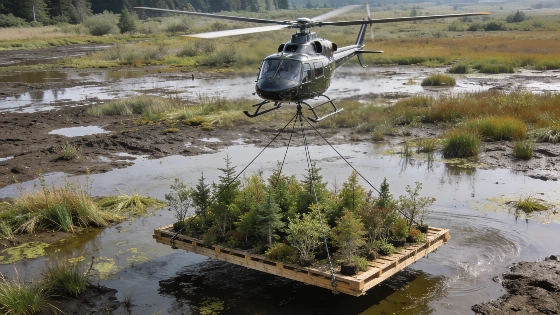
In a bold ecological experiment, the Tulalip Tribes used a helicopter to install 90 pre-planted wooden platforms in a Washington wetland overrun by invasive grass. Early results show most trees survived, but the project’s long-term impact on native vegetation and salmon habitat remains under review.
On October 12, 2023, a helicopter hovered over a remote wetland near Startup, Washington, lowering nearly 90 wooden platforms packed with native trees and shrubs onto saturated ground. The operation, led by the Tulalip Tribes’ Department of Natural Resources, marked the start of an ambitious five-year experiment to reclaim a landscape dominated by the invasive reed canarygrass (Phalaris arundinacea).
Each platform, assembled at the Wallace Creek Hatchery, carried a young native tree and four shrubs, totaling around 450 plants. The platforms were designed to create small vegetated mounds in areas where deep channels and active beaver populations made ground access dangerous. Helicopter delivery allowed the team to avoid damaging the fragile wetland with heavy vehicles, a method increasingly used in river and wetland restoration across the Pacific Northwest.
Testing Restoration Methods
The project was structured as a controlled experiment. Nine plots were established: three received the pre-planted platforms, three were planted with 350 live willow stakes each, and three were left untreated as controls. Each plot measured roughly 15 by 18 meters. Before installation, researchers measured existing plant cover to provide a baseline for future comparisons.
This design allows the team to compare the effectiveness of the new platform method against traditional willow staking and natural recovery. The goal is to determine which approach best supports native vegetation and suppresses the invasive grass by creating shade and competition.
Early Results and Ongoing Monitoring
Initial monitoring in May 2024 brought cautious optimism: nearly all trees on the platforms survived the first winter, though some platforms were disturbed by a bear. According to the Snohomish Basin Salmon Recovery Technical Committee, each plot with 30 platforms cost about $9,519 to install. However, these early survival rates are not yet proof of ecological recovery. The project will be monitored annually for at least five years, tracking whether native plants can establish themselves and reduce the dominance of reed canarygrass.
As of 2025, no final data on the reduction of invasive grass cover had been published. The project’s success will depend on whether the new vegetation can persist and provide enough shade to suppress the grass, which forms dense monocultures and clogs channels critical for fish and wildlife.
Why Reed Canarygrass Is a Problem
Reed canarygrass is considered a major threat to Washington’s wetlands. It crowds out native plants, reduces habitat quality for wildlife, and accelerates the filling of channels used by salmon and other species. The hope is that establishing native trees and shrubs will eventually restore ecological balance and improve conditions for juvenile salmon before their migration to the ocean.
This experiment is part of a broader trend in ecological restoration, where innovative methods are tested to combat invasive species and revive degraded habitats. Similar challenges with invasive pests and plants have been reported elsewhere, such as the persistent weevil infestations in Spanish pantries during summer, as detailed in this recent analysis.
For now, the Oxbow Wetland Pallet Project remains under close observation. Its outcome could influence future restoration strategies in wetlands and floodplains across the region, but definitive results will only emerge after several more years of monitoring and data collection.