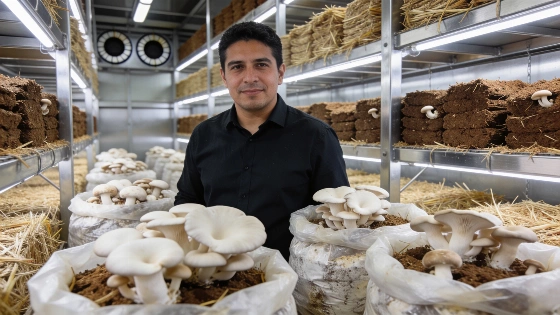
Santiago Jaramillo Mejía arrived in Argentina for a university exchange and ended up founding Micelio Bio, a company that transforms agricultural waste into high-quality oyster mushrooms. Now producing a ton per month, he aims to expand across Latin America.
When Santiago Jaramillo Mejía landed in Argentina in 2004, he expected a brief academic stint. Instead, the Colombian agronomist and biotechnologist found a new home, a family, and a business that now produces one ton of gourmet gírgolas (oyster mushrooms) each month from a small facility in Chascomús, Buenos Aires province.
Jaramillo’s fascination with fungi began in Colombia, where he and his father—also an agronomist—experimented with mushroom cultivation after the family’s flower export business collapsed. In Argentina, a chance meeting with mycology expert Edgardo Albertó led him to the Instituto Tecnológico de Chascomús and a research grant from CONICET. His doctoral work focused on standardizing oyster mushroom cultivation for local conditions, testing substrates and refining pasteurization methods that would later underpin his commercial success.
Although he did not pursue a formal research career, Jaramillo’s scientific background shaped his approach to production. At Micelio Bio, founded after merging with Mü Hongos and building on the experience of La Honguera, he applies circular economy principles: agricultural byproducts like wheat straw, brewery waste, sunflower husks, rice hulls, grape pomace, and coffee husks become the raw material for mushroom growth. The process is efficient—60 bags of three kilos each are produced daily, with mushrooms ready for harvest in about five weeks, using minimal water and space.
From Waste to Protein
Micelio Bio’s model is built on the idea that what others discard can become valuable food. The company uses poplar sawdust from discarded fruit and vegetable crates, enriched with soybean expeller, as its main substrate. After harvest, the spent substrate is distributed to local gardeners for composting or soil enrichment, closing the loop and reducing waste.
Fresh mushrooms remain the company’s core product, sold mainly through digital channels in Buenos Aires and to local hotels and restaurants. Facing economic headwinds, Micelio Bio has diversified into longer-lasting products like gírgola-based milanesas and is experimenting with new varieties such as shitake, perla negra, pholiota, lion’s mane, and Ganoderma lucidum, the latter prized for its medicinal properties.
Scaling Up in Latin America
With demand for healthy, sustainable foods rising, Jaramillo has set his sights on regional expansion. He recently returned to Colombia to launch a family-run operation using shipping containers for production, aiming to introduce mushroom-based burgers and milanesas to new markets. The company’s approach—combining scientific rigor, resource efficiency, and a commitment to circularity—positions it well for growth as Latin American consumers seek alternatives to traditional proteins.
While Micelio Bio’s story is rooted in Argentina, it reflects a broader trend of entrepreneurs leveraging biotechnology and sustainability to create value from waste. As the sector evolves, legal and regulatory frameworks—such as those discussed in the context of family planning and health in recent coverage of preventive legal tools—may play an increasing role in shaping the future of food innovation across the region.