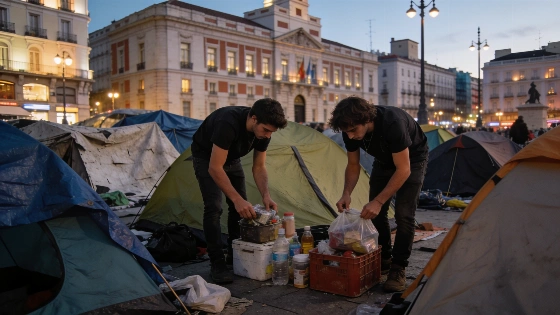
An improvised camp appeared in Madrid after Maricarmen's eviction. Within days, Sol held more than 1,200 tents and a movement demanding structural action on housing.
At about 8:30 p.m. on Saturday 26 September, Valeria Racu told Pablo Pérez that people were collecting tents and heading for Puerta del Sol. The message came two hours after the march began. Tens of thousands had taken to the streets for Maricarmen and a housing decree.
Within days, more than 1,200 tents filled the square. The camp had no central plan when it began after Maricarmen's eviction. Soon, its organisers had to handle food, security, sanitation and political decisions in one of Madrid's busiest public spaces.
It grew fast.
Вечером 2 октября первый правительственный декрет по жилью был отклонён в Конгрессе со счётом 178 против 172.
Pérez was one of the Madrid Tenants' Union spokespeople involved in those first improvised hours. He later said the occupation was far less coordinated than many people assumed. The union had spent the previous week denouncing the housing crisis, but the eviction gave wider anger a clear focus. Many people felt they had lost control of their own lives.
That is why the camp mattered.
Madrid's Government Delegation estimated the Saturday crowd at 25,000. Organisers put the figure at 300,000. Protesters demanded a housing decree that was later split into two measures before a vote in Congress on Friday 2 October.
Both measures failed. The first was rejected by 178 votes to 172. The second lost by 184 to 166. The opposition went beyond PP and Vox. Junts and UPN opposed the first measure. PNV and Coalición Canaria also opposed the second, according to Euronews and reports from the Spanish Congress vote.
Первый декрет должен был продлить до 2030 года защиту уязвимых арендаторов и ограничить спекулятивные покупки. Второй предусматривал более простое автоматическое продление договоров аренды — обе меры были отклонены парламентом.
By Sunday morning, hundreds of people were sleeping in Sol and demanding action to bring housing costs into balance. The setting made the contrast hard to miss. In one of Madrid's most expensive areas, the price per square metre was around €7,000, according to an initial search of property portals.
Alicia del Río of the Tenants' Union said the camp would continue if Pedro Sánchez's Government failed to approve what public discussion had started calling the Maricarmen decree.
The reason was simple.
The occupation had no single command structure. Assemblies decided how to keep walkways open, how to represent different demands and how to supply people through nights outdoors. Some meetings filled the square late in the afternoon. Smaller groups handled practical problems that protests usually face only after they become permanent.
Improvisation built the camp's infrastructure. Mop handles held up tarpaulins. Other canopies offered food, drinks, hygiene products, earplugs, coffee, sanitary pads, medicines, books, board games and hand sanitiser. Donation points gathered supplies. Volunteers also tracked shortages such as ice.
A separate report on Barcelona's housing protest shows that housing demonstrations were appearing elsewhere too. Madrid's camp developed its own way of occupying public space. Reuters and the Associated Press described Sol as a symbol of wider anger over housing that had become harder to afford, not only as a protest over one eviction.
The camp's layout soon became political. Cardboard signs and hand-drawn maps divided the square into areas called Avenida de Maricarmen, Plaza Lésbica, Lucha de clases, Calle Barrikadas and Dictadura del proletariado. These names were more than decoration. They showed how a protest over one eviction was turning into a wider fight about class and housing.
That raised a dispute inside the camp. Alex, 28, had stayed since the Saturday march. He wanted the movement to force a structural response before it entered institutional debates. Laura, 32, worked early and travelled between her home and the camp. She feared formalisation would follow the path of 15M and weaken the movement's class focus.
The union also stressed that camps alone do not stop evictions. Daily organisation and sustained work do. Educators, social workers, neighbourhood associations, Greenpeace and political groups were present in Sol. Their involvement connected the occupation to campaigns beyond housing.
Night changed the pace.
Lanterns lit the tents as people sat in circles, talked and passed the time. Volunteers watched the entrances and challenged people who seemed too drunk or likely to disrupt the camp. Police remained visible around the site, but no forced eviction had taken place. Some participants took turns at work so every tent stayed occupied.
Tourists continued to pass through Sol. Travellers stopped for photographs, asked questions in English and sometimes crossed the improvised routes during free tours. Public debate had moved into the centre of Madrid's commercial and tourist life. It was no longer limited to a meeting room or a parliamentary chamber.
After the votes, protesters kept pressing the government. Euronews reported that they marched towards Puerta del Sol and called for a nationwide strike. Reuters said the government viewed the defeat as a serious blow to Pedro Sánchez's political agenda. Later reports linked the crisis to discussions about a possible early election.
The camp began spontaneously. Necessity gave it structure almost at once. Tents made the protest visible. Assemblies set its rules. A supply network helped it last.
The camp did not solve Madrid's housing crisis. It did something else. An eviction became a collective demand for structural action, and that demand reached the city's most recognisable square.