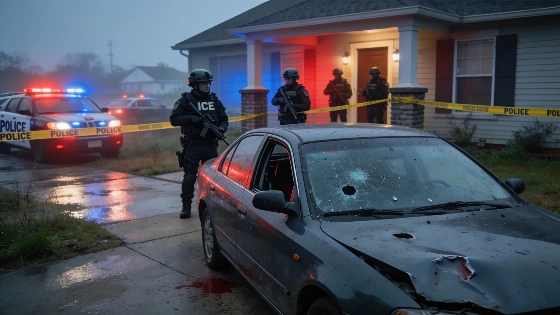
A Mexican national was fatally shot by a U.S. Immigration and Customs Enforcement (ICE) agent in Houston’s Magnolia Park neighborhood at about 6:50 a.m. on July 7, 2026, near the 6800 block of Canal Street. Lorenzo Salgado Araujo, a 52-year-old construction worker, had reportedly lived in the United States for about 35 years and had three children in the country. He was taken to a hospital, where he died from his gunshot wounds.
ICE and the Department of Homeland Security (DHS) said Salgado Araujo ignored repeated verbal commands, rammed an ICE vehicle and tried to run over an officer, who fired in self-defense. Passengers and other accounts disputed that he had tried to run over an agent. Later reporting indicated that Salgado Araujo and his brother were not the operation’s intended targets: agents were reportedly looking for someone believed to be inside the white work van. The conflicting accounts put the circumstances surrounding the use of deadly force at the center of the investigation.
DHS confirmed that the officers involved did not have body cameras. Later reporting identified the agent who fired the fatal shot as Gregory Feathers, a retired ICE agent who had recently rejoined the agency. The identification was attributed to The Texas Tribune; as of October 22, no criminal charges against Feathers or other agents involved had been reported.
The Department of Homeland Security’s Office of Inspector General has launched an investigation into the shooting, while the FBI is focusing its inquiry on the alleged assault against the agent. Harris County District Attorney Sean Teare is pursuing a local criminal investigation. He criticized the federal government’s refusal to provide standard evidence, calling it “unacceptable and unprecedented.” Harris County has reportedly committed $2.5 million to an independent investigation. The federal government’s handling of evidence has become a separate accountability issue from whether the shooting was justified.
The shooting occurred during an immigration-enforcement operation, not while Salgado Araujo was in ICE custody. The original account placed the attempted arrest at around 7 a.m. local time and said ICE described the operation as targeting him. Later reporting offered a different account of whom agents were seeking. A Houston vigil honoring Salgado Araujo was held on July 11, with U.S. Representative Al Green and community groups taking part.
The death has also drawn attention amid wider concern over Mexican nationals who have died in ICE custody. Later Mexican government reporting cited by El País said the death of Emiliano Andrade Covarrubias, a 56-year-old Mexican man at a processing facility in Laredo, brought the reported number of Mexican nationals who had died in ICE custody during Donald Trump’s second term to 18. President Claudia Sheinbaum said Andrade’s family reported that he had diabetes and hypertension and may not have received all the medication he needed. The same reporting identified Félix Alcorta Rodríguez, 63, as another Mexican national who died that year at the Webb County detention center.
The Mexican government has also called for investigations into deaths involving U.S. authorities. The original account said President Claudia Sheinbaum was seeking answers after the death of 45-year-old Jesús Molina Veya, who was found unconscious with a cord around his neck at Georgia’s Stewart Detention Center and later died in hospital. Sheinbaum stressed the need to protect Mexicans’ human rights abroad and called for a full investigation into the circumstances.
U.S. immigration policy has grown increasingly strict since Donald Trump returned to the White House. The administration set an ambitious target of detaining 100 million migrants, intensifying enforcement nationwide. Gregory Bovino, a former chief of the Border Patrol, was a prominent figure in this approach until his dismissal in February after controversial deaths of U.S. citizens during ICE operations. In an interview with The New York Times, Bovino later said he wished he had apprehended even more undocumented immigrants.
The Houston shooting became a focal point for local criticism of ICE operations. In October, a Houston-area coalition declared an “ICE emergency,” saying enforcement actions continued without meaningful accountability. The case was also discussed alongside a later Houston-area incident in which a migrant was reportedly struck by an ICE vehicle while agents sought another person. Local prosecutors were investigating that incident as well as the July shooting.
The incidents have intensified debate over the conduct of U.S. immigration authorities and the risks people face during enforcement actions. Investigators are expected to examine the sequence of events and the use of force. Migrant deaths in custody have also drawn attention in Spain, where public memory and official responses to violent incidents remain under discussion, as highlighted in a recent report on generational gaps in awareness of past tragedies.
ICE is the principal U.S. agency responsible for enforcing immigration laws and detaining undocumented migrants. Its operations have long been controversial, with human rights organizations and foreign governments raising concerns about detainee safety and transparency in investigations into deaths and use of force. The Houston case has renewed calls for independent investigations, with evidence disclosure basic to demands for clarity about federal use-of-force practices as local and federal inquiries proceed.