After a series of car-related wildfires in Spain, many drivers are questioning whether carrying a fire extinguisher in their vehicle is legal or even required. The answer is more nuanced than most expect.
Several major wildfires this summer have been traced back to vehicles, raising urgent questions about fire prevention on Spanish roads. While electric cars are often blamed, studies show they are not the main culprits. Instead, the focus has shifted to whether drivers can or should carry a fire extinguisher in their car to stop a small fire before it spreads.
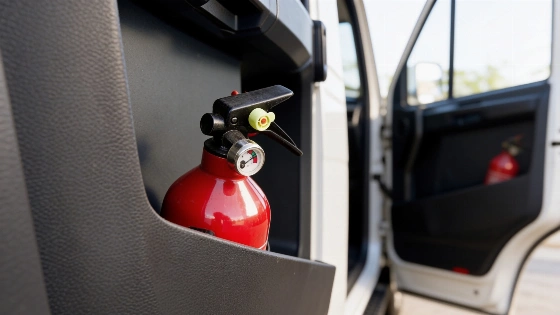
Spanish law does not prohibit carrying a fire extinguisher in a private vehicle, nor does it require it for most drivers. For the vast majority of cars, having an extinguisher is entirely legal and, in some cases, recommended. The only stipulation is that the device must be securely fastened—either in the trunk or anchored to a fixed part of the chassis—so it does not become a hazard in the event of sudden braking or a collision.
Legal Requirements and Exceptions
There is no obligation for private cars to carry a fire extinguisher under the Reglamento General de Circulación (RGC), which governs traffic rules but not vehicle equipment. The Reglamento General de Vehículos (RGV) is more specific: only certain vehicles—such as buses, mixed-use vehicles, and trucks over 3,500 kg—are required to have an approved fire extinguisher on board. For regular passenger cars, the mandatory safety items remain the V16 warning beacon, a reflective vest, and tools for changing a tire.
Bringing your car to the ITV (vehicle inspection) with a fire extinguisher installed is not a problem, provided it is properly secured and does not interfere with safety systems or controls. Inspectors will only check the extinguisher’s condition and certification if your vehicle falls into the category that requires one by law.
Practical Considerations
The Dirección General de Tráfico (DGT) supports the voluntary use of fire extinguishers, noting that they can be useful in the early stages of a fire. However, the agency emphasizes that personal safety comes first. If a fire is already spreading or poses any risk to occupants, the correct action is to leave the vehicle immediately, move to a safe distance, and call emergency services.
Small portable extinguishers can be effective, but only if the fire is detected early and limited to a small area. Once flames reach the engine compartment, cabin, or—especially in electric vehicles—the battery, a standard extinguisher is unlikely to be sufficient. In such cases, experts recommend prioritizing evacuation and alerting authorities to prevent the fire from escalating.
Context and Trends
Interest in vehicle safety features is growing, as seen in recent surveys where comfort and safety equipment are top priorities for car buyers. For example, a recent study highlighted how drivers increasingly value features that enhance both comfort and security.
In summary, Spanish law allows drivers to carry a fire extinguisher in their car, but does not require it for private vehicles. The key is to ensure it is properly installed and does not compromise safety. For those who choose to equip their car with an extinguisher, it can offer peace of mind—but it is not a substitute for professional emergency response when a fire breaks out.
Additional context: Fire safety regulations in Spain are periodically reviewed, especially after high-profile incidents. While the law currently focuses on commercial and heavy vehicles, ongoing public debate could influence future requirements for private cars. For now, carrying a fire extinguisher remains a personal choice, guided by practical safety considerations rather than legal obligation.