A new ISW scenario examines a limited Russian operation in Estonia. Narva could face drones and hybrid pressure aimed at testing NATO's unity.
A limited Russian operation in Narva could test NATO without starting with a full-scale invasion. The scenario from the Institute for the Study of War places Estonia's border city at the center of a campaign built around local unrest, propaganda, and tactical drones. The goal would be political as well as military: force the alliance to decide how far its collective defense commitment extends.
ISW does not describe an invasion as an established plan. It says a large-scale Russian attack on a NATO state is extremely unlikely. At the same time, it warns that Vladimir Putin has other conventional options for escalation.
ISW отдельно отмечал, что не видит признаков российского наращивания сил у стран Балтии. Сценарий о Нарве рассматривается как гипотетическая проверка реакции НАТО, а не как прогноз неизбежного нападения.
Narva is presented as the most vulnerable setting in this hypothetical case. The city has a largely Russian-speaking population and has faced an intense propaganda campaign on Russian social media channels. Propastop previously reported messages showing separatist maps and symbols. They also called for sabotage and protests.
The imagined operation would start inside the city, not with a broad armored advance.
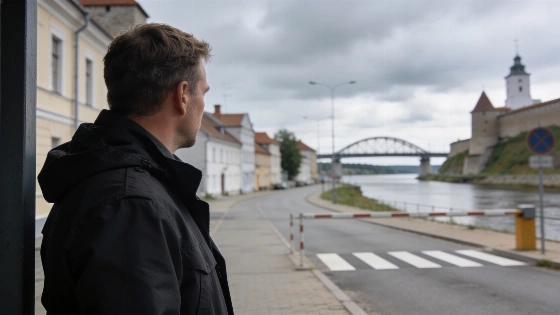
According to the ISW analysis, Russian agents already operating in Narva could seize public buildings and areas near the border bridge and riverside promenade. The study names the Narva Museum and the City Government building as possible targets. The group would then proclaim a so-called People's Republic of Narva and ask Moscow for protection, claiming that Estonia's Russian population was being persecuted.
На фоне публикации сценария российская сторона временно ограничивала доступ к участку границы напротив Нарвы. По данным ISW, ограничения действовали с 16 по 26 сентября и затрагивали передвижение, выход к реке Нарве и ношение оружия в отдельных зонах.
That narrative would let the Kremlin deny launching a direct invasion. Moscow could present the crisis as an internal Estonian matter and say its role was limited to protecting Russian citizens. The political language would matter because the operation would aim to create uncertainty before NATO agreed on a military response.
The proposed support would involve several types of unmanned systems. FPV drones, loitering munitions, and longer-range aircraft launched from Russian territory could target routes used by Estonian forces. The systems described in the study could reach up to 60 kilometres. They might also be supported by relay stations in the Baltic Sea. ERR, citing the scenario, pointed to possible electronic warfare and fibre-optic FPV drones that could make it harder for Estonian and allied forces to move near the border.
That range would matter because Narva lies about 40 kilometres from the Jõhvi military base. The ISW scenario suggests Moscow would use drones to slow or block an Estonian move towards the city while avoiding a large ground deployment. A wider operation could consume resources committed to the war in Ukraine and trigger a stronger NATO response.
The wider pressure around the Baltic region provides the immediate context. Sweden and Germany have held exercises there. Spanish fighter aircraft have monitored Russian planes over the sea. A Kremlin missile struck two kilometres from Poland's border. Poland has responded by strengthening its military posture. Prime Minister Donald Tusk told Parliament that intelligence assessments pointed to a Russian plan involving hybrid attacks with drones and missiles against countries supporting Ukraine. Emmanuel Macron has issued a similar warning in recent days.
ISW identifies several possible aims behind a limited strike. Moscow could try to force a dispute over the application of Article 5. It could split cooperation between the United States, Europe, and the Baltic states while diverting resources from Ukraine. The crisis could also deepen political disagreements over the scale and form of any response to Russia, giving more room to Eurosceptic and anti-NATO parties.
Estonian authorities have tried to separate the hypothetical exercise from an immediate security warning. According to the Estonian Ministry of the Interior, the situation on the eastern border remained calm on September 20. Foreign Minister Margus Tsahkna also said he did not consider Narva to be "next." That supports the government's position that the ISW scenario should not be read as a forecast of an imminent attack.
The scenario matters because the line between a local operation and an attack requiring an alliance-wide decision is narrow. A Russian move in Narva would not need to seek territorial conquest to create a strategic crisis. Propaganda, local proxies, and drones could make hesitation part of the operation. ISW therefore presents the main danger not as an inevitable invasion, but as a calculated attempt to turn a limited incident into a test of NATO's cohesion.