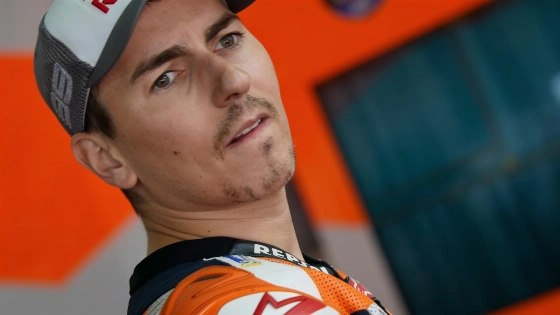
Jorge Lorenzo, five-time world champion, describes MotoGP as an act of extreme risk, highlighting the mental and physical demands on riders who push machines beyond 370 km/h. His candid reflections shed light on the hidden dangers behind the sport’s glamour.
Jorge Lorenzo, one of MotoGP’s most decorated riders, has delivered a stark assessment of the sport that made him a global name. In a recent interview, the Mallorcan champion described the reality of racing at the highest level as bordering on 'barbaric,' pointing to the extraordinary risks and relentless psychological pressure faced by those who compete at over 370 km/h.
Lorenzo, who claimed five world titles during his career, did not shy away from the darker side of his profession. He spoke openly about the physical pain, repeated injuries, and the ever-present threat of disaster that define life in the premier class. According to Lorenzo, the act of strapping a human being onto a machine of two wheels, a handful of metal parts, and a supercharged engine, then sending them down a straight at speeds that rival jet aircraft, is nothing short of an 'animalada'—a wild, almost inhuman feat.
He emphasized that, away from the adrenaline of the track, the sheer vulnerability of riders becomes clear. A minor mechanical failure or a split-second miscalculation can have fatal consequences. Yet, this does not diminish the sport’s appeal; instead, it highlights the immense courage and psychological resilience required to compete at this level.
Lorenzo recalled racing with broken bones, sometimes just hours after surgery, and the pressure to return to the bike before fully healing. He described the mental state needed to ignore pain and fear, a mindset that only becomes fully apparent after retirement. The technical evolution of MotoGP bikes, with their unprecedented acceleration and aerodynamic advances, has pushed speeds to historic highs, further narrowing the margin for human error.
He noted that today’s riders face even greater risks, as modern machines demand superhuman strength to control under braking and unwavering focus to navigate corners at over 200 km/h. The physical and mental demands, Lorenzo argued, make MotoGP one of the most punishing sports on the planet.
Beyond the danger, Lorenzo reflected on the psychological armor riders develop to suppress their survival instincts. While racing, he said, competitors cultivate a kind of voluntary blindness to risk, allowing them to operate at the limit without being paralyzed by fear. But once the racing stops, memories of high-speed crashes and near-misses take on a new gravity, and the true scale of the risks becomes impossible to ignore.
Despite describing the sport as a 'barbaric' pursuit, Lorenzo acknowledged the unique passion it inspires among both riders and fans. The rush of adrenaline and the constant challenge of defying the impossible are, in his view, what make MotoGP so captivating—and what elevate its athletes to the status of heroes. This fascination with speed and danger is not unique to motorcycle racing; as seen when footballers like Marcos Llorente draw attention for their high-performance vehicles, the allure of pushing limits resonates across sports and cultures. For example, Marcos Llorente’s arrival at Atlético de Madrid in a €350,000 Ferrari recently sparked similar conversations about the intersection of risk, technology, and public admiration.
Lorenzo’s candid perspective brings renewed focus to the fine line between sporting achievement and personal safety. Behind the podiums, sponsorships, and global spectacle, MotoGP remains a test of human limits—demanding not only technical skill, but a willingness to face danger that few can truly comprehend.
For context, MotoGP bikes now routinely exceed 360 km/h on the fastest circuits, with riders subjected to extreme G-forces and minimal protection. The sport’s governing bodies continue to seek improvements in safety, but as Lorenzo’s words make clear, the essence of motorcycle racing will always involve a level of risk that sets it apart from almost any other discipline.