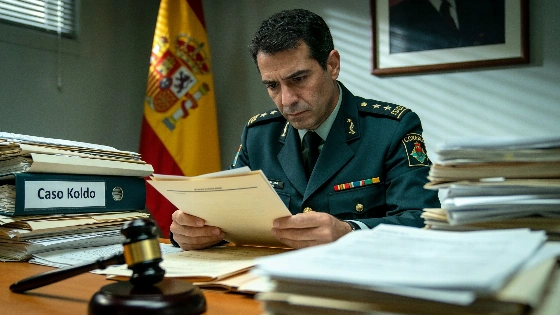
The National Court and anti-corruption prosecutor urge that Antonio Balas continue leading the ‘Caso Koldo’ probe, even as his promotion to colonel nears. Interior may keep him in his post through a special commission.
The future of the high-profile ‘Caso Koldo’ investigation has come under scrutiny as the National Court judge Ismael Moreno and anti-corruption prosecutor Luis Pastor formally requested that teniente coronel Antonio Balas remain in charge of the case, even as he is set to be promoted to colonel by the end of August. This unusual move highlights the importance of continuity in the anti-corruption probe, which has already led to convictions of prominent figures.
Balas, currently leading the Department of Economic and Anti-Corruption Investigations within the Guardia Civil’s Unidad Central Operativa (UCO), faces a procedural hurdle: his promotion would typically require a change of post. However, both the judge and prosecutor have asked the head of the UCO, coronel Pedro Merino Castro, to keep Balas at the helm of the investigation. The Ministry of Interior has the authority to extend his assignment through a ‘comisión de servicios’, a temporary measure that allows an officer to remain in a post outside their formal rank for up to a year, and sometimes longer in exceptional cases.
Sources within the Guardia Civil describe such arrangements as common, especially when operational needs demand stability. A recent example within the UCO saw the head of the anti-narcotics division remain in his role for several months after his own promotion, due to ongoing investigations. In Balas’s case, the request is further strengthened by the fact that it comes at the joint urging of both the judiciary and the prosecution, with the prosecutor emphasizing Balas’s central role in uncovering alleged corruption involving former Transport Minister José Luis Ábalos and his ex-advisor Koldo García.
The final decision, however, does not rest solely with the UCO’s leadership. After coronel Merino, the matter must be escalated to general Alfonso López-Malo, head of the Guardia Civil’s Judicial Police, and then to the State Major, which oversees personnel policy. If approved, the position of teniente coronel in the anti-corruption department would be administratively blocked, preventing others from filling the vacancy and allowing Balas to continue his work. According to several sources, this administrative solution has been used repeatedly in the past and is expected to be applied again in this case.
Balas has become a key figure in Spain’s anti-corruption efforts, having led sensitive investigations that have touched the highest levels of government and the PSOE. He directed the search of the office of then Attorney General Álvaro García Ortiz in October 2024 and was instrumental in producing the report that implicated the Attorney General in leaks related to Alberto González Amador, partner of Madrid’s regional president Isabel Díaz Ayuso. Balas also provided crucial testimony in the Supreme Court trial that resulted in a two-year disqualification sentence for revealing secrets.
His leadership in the ‘Caso Koldo’ probe has been particularly significant. The investigation began with allegations of bribes exchanged for public mask contracts during the pandemic and expanded to the Supreme Court with the indictment and eventual conviction of Ábalos, García, and intermediary Víctor de Aldama. The case remains active in the National Court, with ongoing lines of inquiry into mask procurement, alleged rigged public works, and cash payments from the PSOE to Ábalos and García.
Beyond ‘Caso Koldo’, Balas has overseen investigations into the brother of Prime Minister Sánchez, who awaits a verdict on alleged irregular hiring in Badajoz, and Begoña Gómez, who faces trial for embezzlement, influence peddling, business corruption, and misappropriation of brand. He is also leading the probe into an alleged criminal organization headed by former PSOE Organization Secretary Santos Cerdán, which, through Leire Díez and associates, allegedly sought sensitive information on judges, prosecutors, and UCO agents—including Balas himself—to undermine cases affecting the government and party.
Recordings from meetings involving Díez reveal the pressure surrounding Balas’s role, with participants expressing concern over his influence on ongoing cases. This climate of tension and high stakes is not unique to ‘Caso Koldo’. In a related development, the legal battle over evidence in another high-profile police case was recently covered in detail, as seen in the report on the former deputy director of the National Police seeking dismissal of a sexual assault case: the ongoing legal dispute over evidence and investigative continuity illustrates the broader challenges facing Spain’s law enforcement and judicial system.
The outcome of the current request will determine whether Balas can continue steering the anti-corruption department through a critical phase. The decision is expected to set a precedent for handling similar cases where operational continuity is at odds with administrative procedures. As the investigation into ‘Caso Koldo’ and related matters continues, the Guardia Civil’s approach to personnel management will remain under close observation.