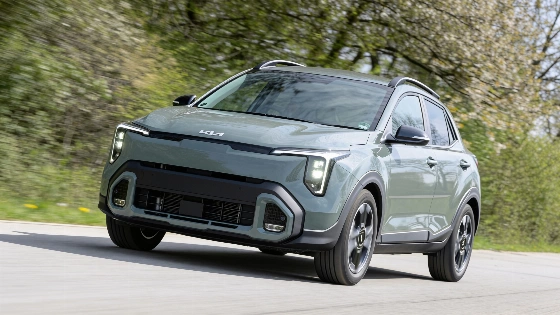
With its latest update, the Kia Stonic 1.0 T-GDI 48V reasserts itself as a compact crossover that pairs a petrol engine with mild-hybrid assistance. Refreshed for Europe after its global debut in 2017, it adopts Kia’s newer design language, with a more upright front end and a bold central Kia badge. Sharply styled headlights complete the look. The GT-Line trim adds a distinctive bumper and Star Map LED signature inspired by constellations.
Despite the visual overhaul, the Stonic retains its urban-friendly footprint. It measures about 4.17 metres long, with a 2,580 mm wheelbase, making it well suited to tight Spanish garages and city streets, including supermarket lots. The rear design echoes the front’s angularity, giving the car a more contemporary presence while preserving its compact proportions.
Interior Space Maximized
Inside, the Stonic makes good use of its space. The front seats offer a slightly elevated, upright driving position with excellent visibility. They are simple but comfortable, with adequate lateral support. The seat base is a bit short and lacks extension, but overall comfort is solid for daily use.
Rear passengers get a fair deal, too. Legroom is not abundant, but headroom is generous, even for taller adults. The pleasantly elevated seating position avoids the low, knees-up posture common in many electric rivals. The overall impression is one of thoughtful design and honest practicality.
The boot is another highlight, with a capacity of 352 litres, expanding to 1,155 litres with the rear seats folded. The parcel shelf can be stowed behind the rear seatbacks when not needed. The maximum payload of 441 kg is more than adequate for a car of this size.
Modern Cockpit, Intuitive Tech
Kia has kept the cabin straightforward and user-friendly. Hard plastics dominate, but varied textures and solid assembly prevent it from feeling cheap. The controls are refreshingly intuitive, a rarity as many rivals chase complexity over clarity.
The centerpiece is a panoramic digital display comprising two 12.3-inch screens for the instrument cluster and infotainment system, standard from the Spirit trim. The graphics are crisp and easy to read, with three different layouts. The updated cabin adds USB-C connectivity and wireless smartphone charging; ambient lighting accompanies Kia Connect services. The multimedia system has a clear menu structure and supports wireless Apple CarPlay and Android Auto.
Efficient Mild-Hybrid Power
Under the hood, the 1.0-litre, three-cylinder turbocharged T-GDi engine is paired with a 48-volt mild-hybrid system. The cited 115-CV version produces 172 Nm of torque; a conventional 1.0 T-GDi rated at 100 CV is also reported for the updated range. In the 115-CV manual configuration, power goes to the front wheels through a six-speed gearbox. Reported figures for that version include a 0 to 100 km/h time of 10.7 seconds and a top speed of 182 km/h.
The 48V system assists the petrol engine rather than turning the Stonic into a full hybrid. It can support engine operation during start-up and allow the combustion engine to switch off while coasting at cruising speed, helping reduce fuel use in suitable conditions. It does not provide electric-only driving, and the car does not need to be plugged in. A seven-speed dual-clutch automatic is also reported for the mild-hybrid model. The 115-CV version feels lively in everyday driving, while its characteristic engine note is audible under load.
Fuel and emissions figures depend on the version and equipment. For the specific 115-CV manual configuration, reported WLTP figures are 5.5 l/100 km and 123 g/km of CO₂. Kia’s Italian model information gives a broader range for the Stonic: 5.3 to 7.7 l/100 km combined and 120 to 133 g/km of CO₂. Those range figures cover different configurations and should not be read as the result for one particular 48V model. The seven-speed dual-clutch transmission shifts smoothly once moving, though there can be slight initial hesitation and occasional jerkiness in stop-start city traffic. At just under 1.3 tons, the Stonic feels stable and composed in town and on the open road.
Balanced Dynamics
The steering is light and easy, if not especially communicative, which suits the car’s relaxed character. Over rough surfaces, the suspension can feel a bit firm or even bouncy, but it never becomes uncomfortable. Braking performance is strong: during testing, the Stonic stopped from 100 km/h in 35.4 metres, an impressive result for its class.
For buyers comparing options in the hybrid crossover segment, the Stonic’s blend of practicality and value stands out. Those interested in how other Asian brands are shaping the market may also want to see how the Honda Civic and Hyundai i30 stack up in the compact hybrid class, as explored in this detailed comparison of hybrid compacts.
Context and Takeaways
The Kia Stonic 1.0 T-GDI 48V pairs a compact crossover design with a mild-hybrid petrol engine, focusing on everyday usability. Its dimensions and manoeuvrability suit Spanish cities, while the updated technology and practical interior help it remain competitive. The mild-hybrid system offers engine assistance and coasting functions without external charging, but the Stonic remains a combustion-powered crossover rather than a full hybrid or zero-emission vehicle. For drivers seeking a practical car that balances comfort and technology for urban use, it remains a compelling choice.