Prosecutors present key evidence linking former Interior Minister Fernández Díaz and top officials to the covert Kitchen operation. The trial highlights how police targeted Bárcenas to obstruct the Gürtel case.
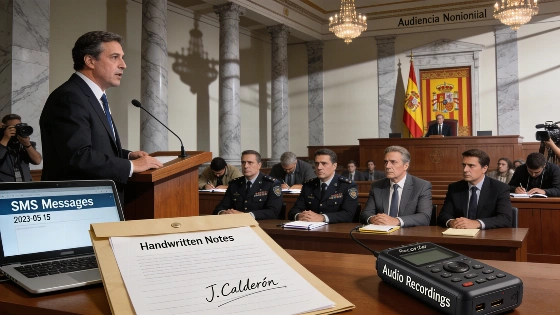
The Kitchen case trial has reached a decisive stage in Spain’s Audiencia Nacional, as prosecutors and private accusers laid out a detailed web of evidence implicating former Interior Minister Jorge Fernández Díaz and senior ministry officials in a covert operation against ex-PP treasurer Luis Bárcenas. The prosecution described the 2013 operation as an illegal police scheme designed to seize sensitive documents that could incriminate high-ranking members of the Partido Popular, aiming to disrupt the ongoing Gürtel corruption investigation.
Central to the prosecution’s argument are a series of SMS messages, secret audio recordings, and handwritten notes from key police figures, including the notorious commissioner José Manuel Villarejo. These materials, presented in court, suggest that the Interior Ministry’s leadership not only authorized but closely monitored efforts to recruit Bárcenas’s driver, Sergio Ríos, as a confidential informant. Ríos’s own testimony, along with corroboration from police officials, confirmed his recruitment and the use of reserved funds to compensate him for information and access.
Prosecutors highlighted that the operation bypassed the official anti-corruption police unit (UDEF), which was already investigating Bárcenas under judicial supervision. Instead, Kitchen was run as a parallel structure, with political and operational directives coming from the top. Evidence from Villarejo’s diaries and audio files revealed detailed plans to locate and seize compromising recordings and documents, including references to possible material stored at Bárcenas’s mother’s home and discussions about sensitive conversations involving Mariano Rajoy and Javier Arenas.
One of the most contentious points is the alleged direct involvement of Fernández Díaz. The prosecution referenced SMS messages reportedly sent by the minister to his then-secretary of state, Francisco Martínez, during critical moments of the operation. Martínez’s testimony and the timing of these messages, which coincide with key entries in Villarejo’s agendas, are presented as proof that the minister was kept informed and exercised control over the operation. Fernández Díaz, however, has denied any knowledge of Kitchen or authorship of the messages.
The trial also exposed the extent of surveillance on Bárcenas’s wife, Rosalía Iglesias, with police officers confirming they conducted monitoring operations on her and her circle without judicial authorization. Documentation and images from these operations were shown in court, reinforcing the claim that the espionage extended beyond Bárcenas himself. Additionally, evidence was presented that Bárcenas was monitored while in prison, with Villarejo’s notes and audio files documenting exchanges of sensitive material between police and ministry officials.
Beyond Kitchen, prosecutors revealed the existence of a parallel project, known as SMP, aimed at uncovering procedural flaws in the Gürtel case that could potentially invalidate the investigation. Documents related to this plan, including a proposed budget of 15 million euros, were found in Villarejo’s possession, further illustrating the lengths to which certain police factions were willing to go to protect political interests.
This high-profile trial has drawn attention to the vulnerabilities in Spain’s political and judicial systems, echoing concerns raised in other recent cases involving leaks and the exposure of confidential information. For example, the debate over privacy and legal loopholes was reignited after the leak of José Luis Rodríguez Zapatero’s agenda and private messages, as detailed in this related report.
The Kitchen case is now on hold until July 22, when defense teams will present their final arguments. The outcome could have significant implications for accountability within Spain’s security apparatus and the boundaries of political intervention in judicial matters. The case also underscores the ongoing challenges in balancing state security, political interests, and the rule of law in Spain’s democracy. As the trial resumes, attention will remain focused on whether the evidence presented is sufficient to secure convictions against former top officials and reshape standards for oversight in future government operations.