León XIV begins a four-day visit to France with major religious and political stakes. Notre Dame and Lourdes will frame a journey shaped by large crowds, tight security and meetings with abuse survivors.
León XIV will make history in Paris on Friday. He will become the first Pope to enter the rebuilt Notre Dame cathedral. His four-day visit, scheduled for 25-28 September 2026, will combine major religious events with meetings on abuse within the Church and a political speech on European peace and unity. The trip will also test France's ability to host huge Catholic gatherings under a security operation comparable to the one used during the 2024 Olympic Games.
The French Government plans to deploy 15,000 security officers in Paris and another 15,000 in Lourdes. Interior Minister Laurent Nuñez said the terrorist threat remains elevated, but intelligence services had found no specific threat linked to the Pope's visit. Authorities are preparing for large crowds in both cities. Church leaders have warned that barriers and police controls should not overwhelm the religious experience. Independent reporting confirms the elevated security risk and major disruption plans, although the precise deployment totals have not been independently verified in the available coverage.
The journey is being presented as the first official papal state visit to France in 18 years, adding historical weight to León XIV’s itinerary beyond the individual ceremonies.
That balance will be hardest to maintain in Lourdes. The Vatican expects about 200,000 believers, pilgrims and curious visitors there. León XIV will meet seven victims of sexual abuse within the Church. Five of them were abused at the Notre Dame de Bétharram boarding school.
Paris will provide the clearest display of Catholic strength.
The Church expects 600,000 people on the Champs-Élysées for the Saturday mass at Place de la Concorde. It also expects a full Stade de France, with 85,000 young people attending a Friday evening ceremony whose format recalls the event held at Santiago Bernabéu. The last papal visit to the French capital was made by Benedicto XVI in 2008.
The Associated Press reports that the Lourdes programme includes a private meeting with seven survivors of sexual abuse. The encounter is intended to make the Church’s response to abuse one of the central human issues of the pilgrimage, rather than a secondary element of the public ceremonies.
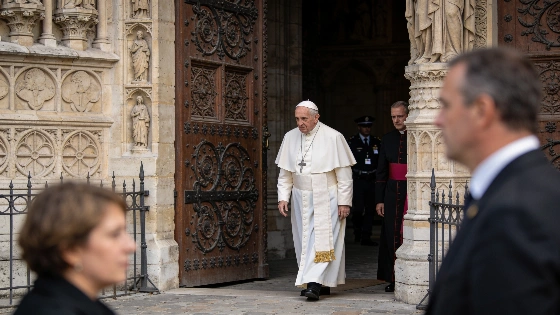
León XIV will arrive at Orly airport on Friday morning and be received by Emmanuel Macron. Francisco visited Marseille in September 2023 and Córcega at the end of 2024. León XIV is taking a different route. He is choosing Europe's capitals and monumental cathedrals to present Christianity from the centre of public life. After blessing the tower of Jesus Christ at Barcelona's Sagrada Familia, he will turn to Notre Dame, almost two years after the restored cathedral reopened following the fire of April 2019.
The cathedral visit is the clearest image of the trip. It will show a Pope entering a building that France watched burn and rebuild. The setting gives the journey a national symbol without putting Macron at its centre. Vatican News describes the service at Notre Dame as a particularly significant moment for French Catholics and for the cathedral's restoration.
A second institutional moment will come at UNESCO. León XIV is due to become the first Pope to speak at the United Nations institution since Juan Pablo II in 1980. His remarks may return to artificial intelligence, a subject addressed in his first encyclical Magnifica humanitas. The book collecting those reflections has sold more than 120,000 copies in French bookshops.
French Catholics have so far received the Pope well. The country's largely moderate and centrist Christian community values his continuation of Francisco's social approach. Traditionalist groups view him more favourably than his predecessor. France 24 has framed the visit against a wider dispute over values in a secular country where abortion is protected by the Constitution and assisted-dying legislation has recently been approved. The contrast with another major public ceremony in Spain appears in an earlier report on Felipe VI's university opening in Cartagena, where public symbolism also shaped the event.
The numbers help explain the anticipation. Baptisms in France rose from just over 100,000 in 2020 to more than 175,000 in 2024. Among those baptised at Easter, the total increased from 4,124 in 2016 to 13,234 this year. Young people and adults who were previously atheist or non-practising drove much of the renewed interest.
The political message will come last in Metz on Monday, before representatives of most European Union countries. The city has historically been disputed between Germany and France. There, the Pope will speak about peace and European unity. Vatican News identifies Metz as the final stage of the 25-28 September journey and places its peace message after the Paris ceremonies and the Lourdes pilgrimage. His agenda moves from a restored cathedral to abuse survivors, then to the future of Europe.
Macron and the Vatican have not agreed on every detail. The French president wanted meetings with the firefighters who saved Notre Dame and the craftspeople who restored it. He also wanted a state dinner that would have given the political side greater weight. The Vatican rejected those proposals. Macron will attend none of the masses celebrated by León XIV, unlike his presence during Francisco's 2023 visit.
France is offering León XIV a stage where Catholic renewal is visible but still contained by the country's secular tradition. The planned crowds in Paris and Lourdes show that the Church has regained public energy. The meetings in Lourdes and the speech in Metz keep the journey from becoming a purely ceremonial tour. León XIV is using France to put Christianity back into Europe's public conversation without allowing security fears or presidential protocol to define the message.