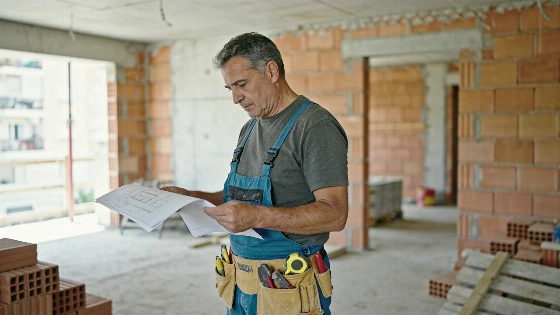
At 75, Rafa Domínguez closed his permanent team and switched to working with three freelancers. His decision reflects a wider crisis: Spain’s construction sector now struggles to find experienced bricklayers, with official data confirming a shortage of candidates and technical skills.
When Rafa Domínguez, a veteran Madrid builder, decided at 75 to let go of his permanent staff and rely on three freelancers, he was responding to a reality that now shapes Spain’s construction sector. His move, shared in a December 2025 interview on the podcast Wall Street Wolverine, was driven by the unpredictability of projects and the rising costs of maintaining a fixed payroll. “There came a point when I said: everyone out,” Domínguez recalled, explaining that the gaps between jobs made it impossible to keep a traditional team. “You finish a house, and if there’s no new project, what do you do with the people?”
Domínguez’s story is not unique. According to a July 2026 report from SEPE, Spain’s public employment service, bricklayers now rank among the hardest positions to fill. The report, based on 2025 data and a 2026 survey, places bricklayers fourth in the list of most difficult roles to cover. More than 57% of companies cited lack of experience as a key barrier, while 87% of SEPE experts pointed to a shortage of candidates and 65% highlighted insufficient experience. Over 60% also noted a lack of technical skills.
Why Permanent Teams Are Disappearing
For Domínguez, the shift to project-based work was a matter of survival. He began his career at 13 alongside his grandfather and spent over six decades in the trade. But as the industry evolved, so did the demands. Today’s construction workers must understand not just masonry, but also installations, climate control, and energy efficiency. The days of learning on the job have given way to a need for specialized training and up-to-date technical knowledge.
Other workers echo Domínguez’s concerns, pointing to the growing gap between what the sector requires and the skills available in the labor market. The SEPE report confirms that the shortage is not simply a matter of young people’s attitudes. It cites a mix of factors: working conditions, training gaps, and a mismatch between available profiles and job requirements. Specialized construction activities top the list of divisions with the biggest hiring challenges, followed closely by building construction.
Freelancers and Legal Boundaries
Domínguez’s decision to work with freelancers raises questions about the legal nature of such arrangements. Spanish law sets strict criteria for economically dependent freelancers, including income thresholds and requirements for genuine independence. The interview does not clarify whether Domínguez’s collaborators met these standards, leaving open the question of whether their relationships were truly commercial or, in practice, more like employment. Registration as a freelancer and issuing invoices alone do not settle the legal status.
Pension Cuts and Unanswered Questions
During the podcast, Domínguez mentioned receiving a pension of €740, reduced by €81 after selling a property. He blamed the tax authorities, but without the official administrative decision or details of his pension type, it is impossible to confirm the exact reason for the cut. Spain’s Social Security system does not guarantee minimum pension supplements if annual income from work, capital, or property gains exceeds €9,442. While a property sale can affect pension entitlements, the impact depends on the specific circumstances and administrative rulings.
Generational Shift and Social Impact
Domínguez’s experience highlights two intertwined issues: the lack of new entrants to skilled trades and the challenge of securing adequate social protection after decades of work. As Spain’s construction sector faces a growing skills gap, the story of one builder’s adaptation reflects a broader struggle to balance economic realities, legal frameworks, and the changing nature of work.