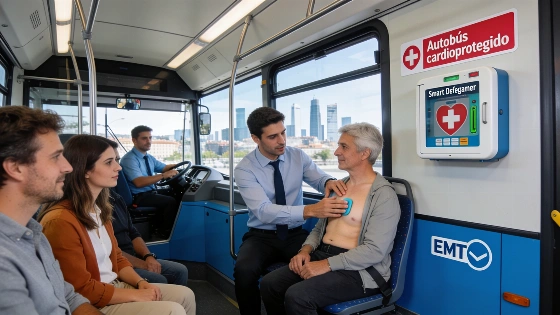
Madrid is installing 2,200 smart defibrillators across its entire EMT bus fleet by October. The devices will be available to passengers and the public, automatically alerting emergency services when used. The initiative is expected to improve cardiac emergency response throughout the city.
Madrid is set to become the first major European city where every municipal bus doubles as a mobile cardiac emergency point. By October, the city council will have completed the installation of 2,200 smart defibrillators on all EMT Madrid buses, a move that Mayor Almeida says "will save lives."
The rollout transforms the capital’s buses into accessible, moving hubs for cardiac protection. Each device is available not only to passengers but to anyone nearby who suffers a cardiac arrest on the street. In an emergency, a bystander can request the defibrillator from the driver while waiting for paramedics to arrive.
Automatic Emergency Alerts
The chosen model, the Reanibex 100, is a Spanish-made automated external defibrillator (AED). When removed from its holder, it instantly triggers a call to 112 emergency services and transmits the bus’s location, allowing responders to pinpoint the incident without delay.
Once activated, the device provides clear voice instructions for attaching pads, performing chest compressions, and knowing when to avoid contact with the patient. It guides users through CPR and, if necessary, delivers a shock. The AED supports both adult and pediatric modes, features real-time geolocation, a metronome for compression rhythm, and remote 24-hour monitoring. Weighing just 2.5 kilograms, it is designed for rapid deployment and ease of use by non-professionals.
Full Fleet Coverage
Installation began in July, and according to Mayor Almeida, around 900 buses were already equipped at the time of the official launch. The city expects to finish the deployment before October, ensuring that nearly every neighborhood and major street in Madrid is covered by this mobile safety network.
The five-year contract, awarded in March to Bexen Cardio (part of the Mondragón Corporation), is valued at €2.9 million excluding VAT. It includes equipment rental, installation, maintenance, and incident management for all 2,200 defibrillators. Buses with the new devices will display a prominent "Autobús cardioprotegido" sticker, signaling to the public that a defibrillator is on board.
Training for Drivers
All EMT Madrid drivers will receive training to respond effectively during a cardiac emergency. However, the AEDs are designed so that any member of the public can use them by following the device’s audio prompts. The goal is to provide immediate assistance in the critical minutes before emergency medical teams, such as SAMUR-Protección Civil, arrive on the scene.
While these devices do not replace professional medical intervention, their automatic activation, direct link to emergency services, and step-by-step instructions can make a crucial difference in survival rates during cardiac arrests.
Expanding CardioMAD
This initiative builds on the CardioMAD project launched in 2021, which initially equipped 176 buses across 11 lines with defibrillators. That pilot involved the city council, EMT Madrid, SAMUR-Protección Civil, the municipal police, and the Madrid Business Forum. The new rollout extends coverage to the entire fleet, with remote monitoring to ensure each device is operational and ready for use.
According to data from Talent24h, Madrid’s approach could serve as a model for other cities seeking to improve public health infrastructure through everyday services. With cardiac arrest remaining a leading cause of sudden death, rapid access to defibrillation is widely recognized as a key factor in survival. The city’s investment in smart, accessible AEDs on public transport marks a significant step in making lifesaving technology part of daily urban life.