Tens of thousands marched across Spain over unaffordable housing. Madrid saw sharply disputed turnout figures, while tenant groups called for a general strike.
On 2 October, Congress rejected a package of housing measures that would have extended tenant protections, adding pressure on Pedro Sánchez's coalition. A day later, protesters filled Madrid and cities across Spain as tenant groups called for a general strike, with no date set.
Organisers said political patience had run out. The Spanish Government Delegation counted 70,000 people in Madrid; the Sindicato de Inquilinas de Madrid put the figure at 500,000. Al Jazeera reported that demonstrations on 3 October reached approximately 50 cities across Spain.
The numbers remain disputed.
Valeria Racu of the Sindicato de Inquilinas de Madrid said the campaign's next stage should come soon. The organisation says eight days of mobilisation have achieved more than eight years of progressive governments. It plans to maintain pressure regardless of which party governs.
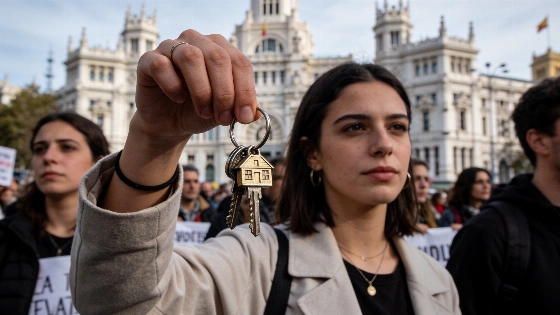
In Madrid, protesters shook their house keys and warned landlords that tenants could stop paying rent. Their slogans targeted Pedro Sánchez's government and Isabel Díaz Ayuso. Protesters also named José Luis Martínez-Almeida, Junts and Miriam Nogueras, accusing the political class of letting rent-seeking interests shape Congress.
Four columns headed towards Plaza Cibeles. The march lasted more than two hours and remained peaceful.
Young people unable to leave their parents' homes stood beside older residents and public-service groups. Those groups said the housing crisis cannot be separated from pressure on schools and other impressive services.
For many younger demonstrators, the problem is immediate. Ester and Carla, aged 23 and 25, live in Vallecas and Vicálvaro. They said they still cannot afford to rent a home on their own.
Andrea, 23, is from San Blas. She, too, has been unable to move out and spent days camping in Puerta del Sol.
The package rejected by Congress included a ban on evictions of vulnerable tenants until 2030, a two-year extension of rent freezes for existing contracts and tighter rules for short-term rentals. Reuters reported that tenant groups saw the defeat as closing an immediate parliamentary route while negotiations over a nationwide strike continued. No date had been set.
The campaign began after 87-year-old Maricarmen Abascal was evicted from her Madrid flat. Reports said her rent was set to rise by 275 percent.
Housing costs are also shaping family decisions. Mireia, a 70-year-old Madrid resident who owns a flat, said separation could leave one person without access to another home.
Virtu, a secondary-school teacher in San Sebastián de los Reyes, described families connected to her daughters' school. Some had to leave their neighbourhoods. Others moved to different autonomous communities after divorce or rent increases.
Puerta del Sol has its own pressure point. A tent camp has stood there for about a week and remains open indefinitely. The Sindicato de Inquilinas says it is no longer responsible for the camp because it grew beyond the organisation's control.
The camp became a gathering point for pressure on the government and Parliament. The tenant union says power now lies in the streets.
Barcelona cancelled its afternoon protest because of rain. Organisers rescheduled it for Monday 5 October at 19:00 in Urquinaona square.
Valencia held its march, but disturbances followed outside a real-estate investment congress at the Palau de les Arts. Efe reported that at least five people were arrested after a group allegedly tried to enter, brought down barriers and threw objects at police. Officers charged some demonstrators and fired rubber bullets.
Pedro Sánchez is also considering early Spanish elections, potentially before the end of 2026. The possibility has not eased criticism of the national government.
Reuters reported that the failed vote added pressure on the governing coalition. Protesters also blamed regional and parliamentary forces for blocking reforms.
The political demand is broad. Organisers want a 50% rent reduction and indefinite contracts. They also want homes removed from speculative funds, along with stronger tenant protections.
The final Madrid crowd total may never be settled. The broader political fact is clearer: tenants have moved the housing crisis from private hardship into sustained public confrontation.
The rejected decrees closed an immediate parliamentary route, while the street campaign gathered momentum.
With the Puerta del Sol camp still open and organisers openly demanding a general strike, institutions cannot treat the movement as a one-day event. A strike would take the dispute beyond marches and camps, bringing it into the daily relationship between tenants and landlords.
Rent is now tied to independence and divorce, with schooling and neighbourhood survival also at stake. That helps explain the range of ages at the demonstrations and why pressure is aimed at every governing option, not one cabinet alone.
Until political institutions produce an answer protesters consider credible, the campaign will test whether Spain's housing policy is shaped in Congress or under pressure from the streets. An earlier turnout report already showed how sharply the crowd estimates diverged.