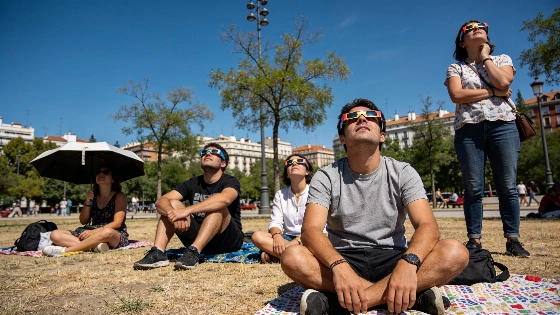
Madrid prepares for a rare solar eclipse with 64 official viewing sites. Authorities warn of extreme fire risk and urge use of public transport. Security and emergency services are on high alert across the region.
This afternoon, Madrid faces a rare solar eclipse under clear skies, but with heightened fire risk and soaring temperatures. Authorities have designated 64 official observation points across 61 municipalities, urging residents to avoid forests and private land due to the extreme wildfire danger and to prioritize public safety. The region is under a yellow alert, with temperatures expected to reach up to 39°C in some areas.
Of the 64 observation sites, 28 are located outside urban areas and 36 within towns and cities. Some, like Buitrago del Lozoya, La Cabrera, and Valdepiélagos, offer large parking areas, but officials still recommend using public transport to reduce congestion and environmental impact. The Ministry of the Interior has accredited all official sites, and last-minute changes saw Valdemanco and Quijorna removed from the list, while Ambite, Canencia, and Lozoya each maintain two observatories.
Not all of Madrid will experience the eclipse in full. The 100% totality band enters from the northwest, crosses the northern third of the region, and exits eastward. In the capital, the southern edge of this band barely touches the city limits, meaning Madrid will see 99.95% coverage—a small difference that matters for eclipse enthusiasts. The longest duration is expected in Somosierra (1 minute 29 seconds), followed by Prádena del Rincón and Braojos. Other towns like Meco, Los Santos de la Humosa, Colmenar Viejo, and Alcalá de Henares will see shorter periods of darkness.
Fifty-one viewing points will host special activities, though Tres Cantos has cancelled its events as a precaution. Buitrago will be the site of a major festival with food trucks, music, and workshops, but all 3,000 free tickets have already been claimed. For those staying in Madrid city, the Ayuntamiento recommends the Parque Forestal de Valdebebas-Felipe VI, as well as popular spots like the Templo de Debod, El Retiro, Cerro Garabitas in Casa de Campo, and the Vallecas park known as 'parque de las tetas'.
Traffic is expected to be heavy, especially on the A-1, M-607, A-2, and A-6 corridors, as well as in the Sierra de Guadarrama and towns such as Buitrago, Somosierra, La Cabrera, and El Molar. The DGT has launched a special traffic operation, and the regional transport authority will reinforce bus lines including 191, 193, 222, 223, 227, 256, 275, 691, 681, 682, 683, 684, 725, 726, and several night routes. Line 275 will offer direct service from Alcalá to Los Santos de la Humosa. Reinforcements will be activated if demand surges after the eclipse ends.
The State Meteorological Agency forecasts clear skies throughout the region, but the heat remains a concern. Residents are advised to bring umbrellas, sunscreen, and certified eclipse glasses. Temperatures will peak at 39°C in Alcalá de Henares and Aranjuez, 38°C in Madrid, Getafe, and Navalcarnero, and 37°C in Collado Villalba, though values are expected to drop by five degrees during the eclipse itself.
Security measures are extensive. Two advanced command posts will operate—one at the Guardia Civil's mountain rescue base in Navacerrada and another at the Buitrago swimming pools. Over 1,700 Guardia Civil and National Police officers are mobilized, supported by regional emergency services. The regional government has activated the Civil Protection Plan, increased fire patrols in the north, boosted firefighter staffing, and added extra emergency call handlers and vehicles in the Sierra de Guadarrama and Sierra Norte.
For those interested in eclipse safety, guidance on protective eyewear and viewing rules has been highlighted in recent coverage, emphasizing the importance of not removing eclipse glasses prematurely.
Solar eclipses are rare events in Spain, with the next total eclipse not expected for several decades. The current event has prompted a coordinated response from authorities to balance public enthusiasm with environmental and safety concerns. Madrid's approach—centralizing observation points, reinforcing transport, and deploying emergency resources—reflects lessons learned from previous large-scale gatherings and the region's vulnerability to summer wildfires. The focus remains on ensuring that residents and visitors can enjoy the spectacle without incident, while minimizing risks to both people and the environment.