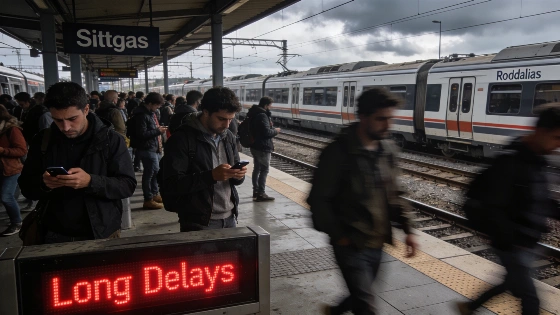
A train malfunction between Sitges and Garraf has triggered delays of over 45 minutes on key Rodalies lines. Service reductions and additional stops are in effect. Authorities address public concern after recent infrastructure incidents.
Rail traffic in southern Catalonia faced significant disruption on Monday after a train broke down between Sitges and Garraf, leading to delays exceeding 45 minutes across the R13, R14, R15, R16, and R17 Rodalies lines. The incident forced Rodalies to reduce service on the R2sud to just two trains per hour in each direction, while trains to and from Sant Vicenç de Calders were required to stop at all stations along their route.
This breakdown comes less than a day after the R2, R2nord, and R11 lines resumed operations following a prolonged suspension caused by a sinkhole in Vallbona, Barcelona, linked to ongoing underground works in Montcada i Reixac. Renfe, the rail operator, has implemented speed restrictions at the affected site to ensure passenger safety. The series of incidents has intensified scrutiny of Catalonia’s rail infrastructure, especially as the region continues to recover from previous disruptions. For context, similar large-scale interruptions have recently impacted the network, such as the cable theft that halted the entire R3 Rodalies line, affecting thousands of commuters, as detailed in this related report.
Compounding the situation, a fire near the high-speed rail infrastructure forced the suspension of AVE services between Camp de Tarragona and La Pobla de Montornés from 9:48 a.m. on Monday. This affected trains on the Madrid-Barcelona high-speed line, according to Adif, adding further pressure to the region’s already strained transport system.
Amid mounting public concern over the frequency of recent rail and infrastructure incidents, Sílvia Paneque, the Generalitat’s Minister of Territory, addressed the issue in a 3Cat interview. She emphasized that the recent accidents—including the Vallbona sinkhole, the Putxet incident related to the L9 line, and a gas explosion in Sants—are unrelated in terms of contractors and responsible parties. Paneque insisted that the country is not “collapsing” and defended the administration’s response, highlighting prompt emergency action and efforts to restore normality.
Regarding the Montcada i Reixac sinkhole, Paneque noted that the Generalitat is still awaiting a full report on the causes. She stressed the complexity of the underground works and stated that any identified improvements would be demanded from Adif to prevent future occurrences. Paneque also acknowledged the erosion of public trust in Rodalies, attributing it to decades of underinvestment and pointing out that 180 improvement projects are currently underway—works she described as both essential and disruptive.
Spain’s rail network, particularly in Catalonia, has faced repeated challenges in recent years, from technical failures to external incidents like theft and fire. The Rodalies commuter system is a critical link for daily travel in the region, and disruptions can quickly cascade, affecting thousands of passengers and local economies. The ongoing investment in upgrades and repairs reflects both the scale of the challenge and the authorities’ recognition of the need for a more resilient transport infrastructure. As incidents accumulate, the pressure mounts on operators and government bodies to deliver lasting solutions and restore public confidence in the reliability of Catalonia’s rail services.