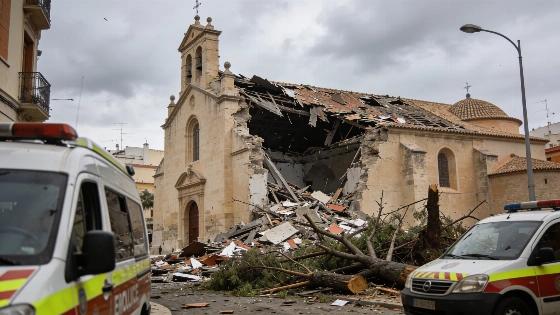
A violent storm has left one person dead and caused widespread flooding across Catalonia and Valencia. With roads cut and thousands of students out of class, authorities now warn the Balearic Islands to brace for severe weather and possible evacuations.
Emergency crews in Catalonia have recovered the body of a man who was swept away by floodwaters in Olivella, Barcelona. His car was carried off by a swollen stream, and firefighters found his body about 500 meters downstream. The overnight downpours hit the Catalan coast and foothills with enough force to make travel dangerous and, in this case, deadly.
As the storm moves east, the Balearic Islands are now on high alert. At 13:24 on Thursday, Protección Civil sent a mass warning to mobile phones in Ibiza and Formentera, urging people to prepare for heavy rain and strong winds. Meteorologists from Aemet have warned that more torrential showers are possible in Cartagena and Mazarrón, where red alerts were issued earlier for rainfall rates reaching 60 litres per square metre in an hour.
Between Wednesday evening and Thursday morning, Valencia’s emergency coordination centre received 1,080 storm-related calls, with 606 coming from the city of Valencia alone.
Valencia’s emergency coordination centre has been flooded with calls, handling 1,080 storm-related incidents between Wednesday afternoon and Thursday morning. More than half came from the city of Valencia. Most emergencies involved pumping out flooded buildings, rescuing stranded vehicles, and clearing blocked roads. Regional emergency services say these numbers show the scale of disruption across the Valencian Community.
Schools in several regions closed for the day. Valencia’s airport and metro were temporarily shut down, and rail services and highways were disrupted, leaving thousands of commuters and students stranded. Authorities have repeatedly asked the public to avoid unnecessary travel, especially in the hardest-hit areas of Ibiza, Formentera, Murcia, and the Valencian Community. Official guidance from Protección Civil and regional governments stresses the need to stay away from riverbeds, ravines, and low-lying areas because of the ongoing risk of flash floods.
Salvador Illa, president of the Generalitat, offered condolences for the loss of life and thanked communities for following safety advice. He also pointed to the growing need for better preparedness as climate change brings more frequent and severe weather events to Spain.
In Catalonia, civil protection alerts were expanded in stages: initial Es-Alert messages were sent at 21:30 to Barcelonès and Maresme, then at 23:10 to Garraf, Baix Llobregat, Vallès Occidental, Alt Penedès, and Baix Penedès, as the risk of flash floods increased.
With the storm’s centre now shifting toward the Balearics, the risk of more flooding and transport problems remains high. Torrential rain, hail, and strong winds are expected to continue through the day, keeping emergency services busy and residents on edge. The Spanish meteorological agency Aemet has placed Ibiza and Formentera under an orange alert, forecasting up to 50 litres of rain per square metre in an hour, with the most intense part of the storm now moving over the Balearic Islands.
This episode shows how vulnerable Spain’s eastern regions are to extreme weather. The need for stronger infrastructure and faster emergency response is clear. As climate patterns change, how well local authorities and communities adapt will shape the outcome of future storms—and how many lives can be protected when severe weather hits.